

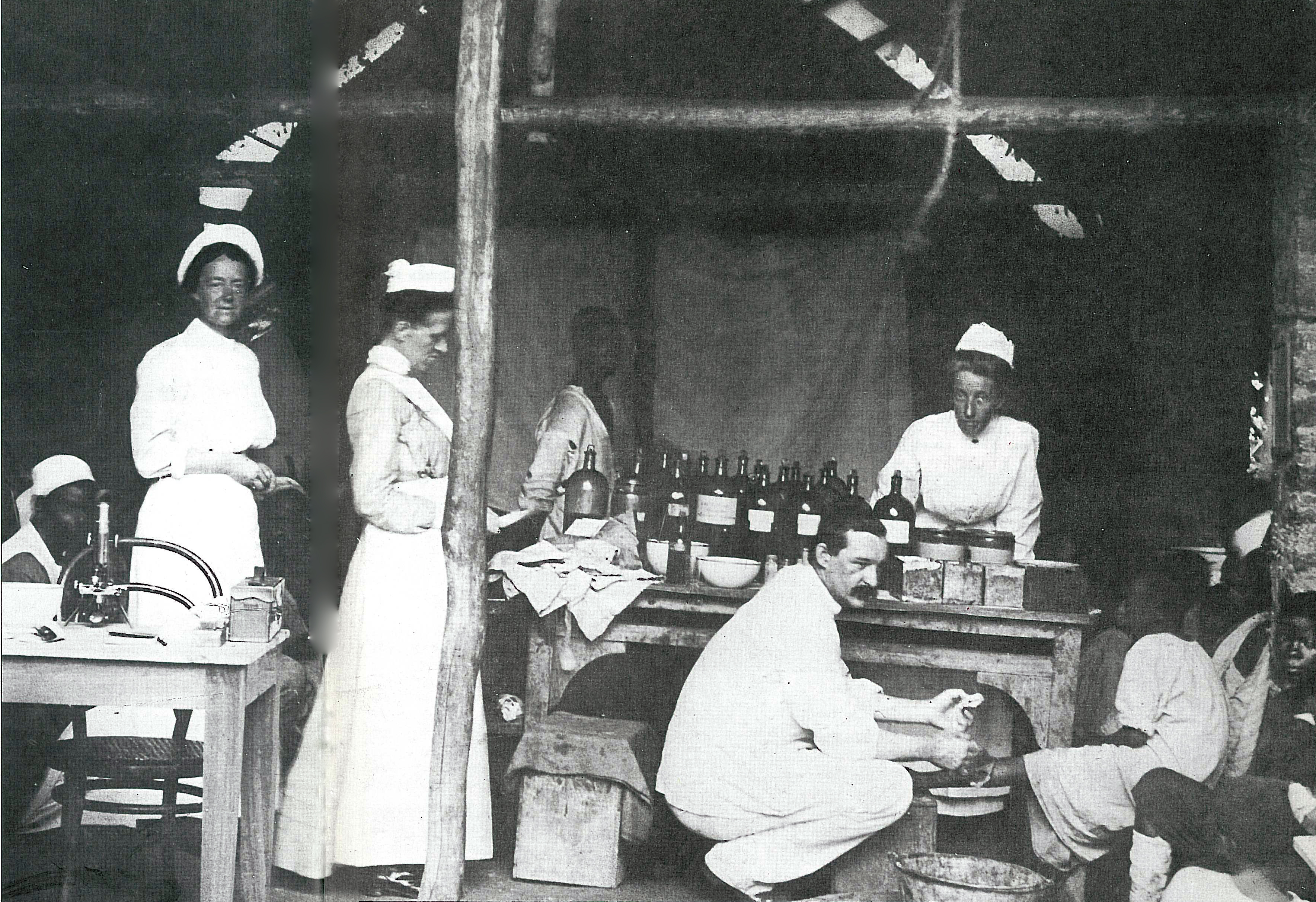
By the late nineteenth century, missionary organisations had become significant providers of medical care across various regions of the British Empire. In territories such as East Africa, Southern Africa, and parts of India and Southeast Asia, missionary stations often served as the first point of contact between European medical practice and local populations. The image from Africa in 1890 illustrates a typical clinical setting: a temporary structure staffed by nurses and medical personnel engaged in basic treatment and laboratory work. Such facilities were frequently established in remote areas, where colonial administrative presence was minimal or absent.
Missionary medicine operated at the intersection of religious outreach, humanitarian service, and practical necessity. While the primary objective of most missionary societies remained religious conversion, medical care was often used as a means of building trust and sustaining long-term engagement with local communities. The Church Missionary Society (CMS), the London Missionary Society (LMS), and the Wesleyan Methodist Missionary Society were among the most active providers of medical services. Their hospitals, dispensaries, and mobile clinics were staffed by trained personnel—some with formal medical qualifications, others with practical nursing experience acquired in Britain or on the field.
The infrastructure of missionary medicine varied widely. In some cases, permanent hospitals were constructed using imported materials and British architectural plans, complete with tiled wards, surgical theatres, and pharmacy stores. In other contexts, medical care was delivered in temporary shelters or adapted local buildings. The 1890 image shows a field clinic with minimal furnishings, suggesting a mobile or provisional setup. Bottles, microscopes, and basic instruments indicate a focus on diagnosis and treatment of infectious diseases, which were prevalent in tropical regions.
Common treatments included quinine for malaria, iodine and carbolic acid for wound care, and rudimentary surgical procedures for injuries and abscesses. Vaccination campaigns were occasionally undertaken, though logistical constraints—such as refrigeration, transport, and record-keeping—limited their reach. Missionary nurses played a central role in administering care, maintaining hygiene standards, and training local assistants. The uniforms visible in the image reflect British nursing conventions of the period, including starched caps and aprons, which were both practical and symbolic of professional identity.
Missionary medical records, where preserved, provide valuable data on disease prevalence, patient demographics, and treatment outcomes. These records were often sent back to headquarters in London or published in missionary journals. They contributed to the broader imperial understanding of tropical disease and informed the development of tropical medicine as a formal discipline. Institutions such as the London School of Hygiene and Tropical Medicine, founded in 1899, drew upon missionary field experience to shape curricula and research agendas.
Coordination between missionary and colonial medical services was uneven. In some regions, missionaries operated independently of government oversight, while in others they received subsidies, supplies, or personnel from colonial administrations. The boundaries between missionary and state medicine were porous, especially during epidemics or military campaigns, when all available resources were mobilised. During the sleeping sickness outbreaks in Uganda and Tanganyika, for example, missionary hospitals were integrated into broader containment efforts.
Training of local medical staff began in earnest in the early twentieth century. Missionary hospitals established nursing schools and medical colleges, often with curricula adapted from British institutions. Instruction was typically in English, with practical training conducted in missionary wards. Graduates sometimes went on to work in government hospitals or to establish private practices. This process laid the groundwork for postcolonial medical systems, though access to training remained limited to select groups.
The image from 1890 is from Likoma Island in Nyasaland and captures a moment in the evolution of missionary medicine: a transitional phase between informal care and institutionalised practice. There is a particularly large collection of disinfectant bottles reflecting the preponderance of insects often carrying deadly diseases. It reflects the logistical challenges of delivering medical services in remote settings, the reliance on trained nursing staff, and the integration of laboratory techniques into field medicine. While missionary medical work was shaped by religious objectives, its operational features—staffing, infrastructure, treatment protocols—contributed to the broader imperial medical landscape and brought many practical benefits to the population at large.
