

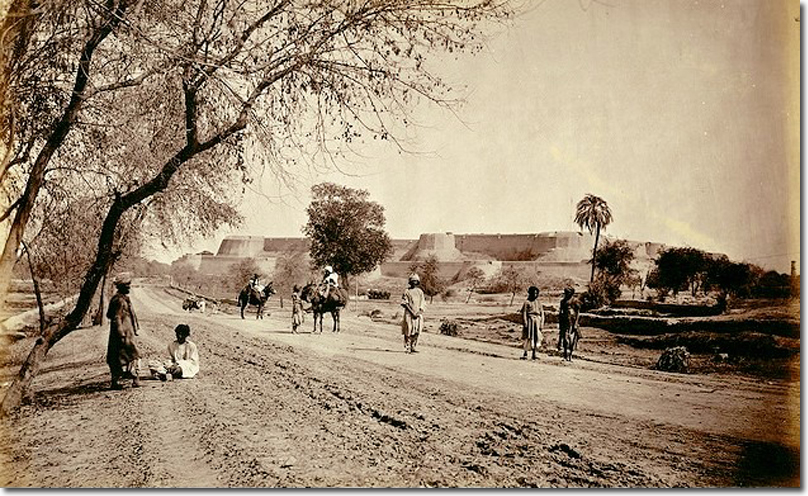
This picture shows Peshawar Fort in 1878 with the Grand Trunk Road in the foreground.
The Grand Trunk Road was one of the most extensive infrastructure projects undertaken in British India. Stretching from Calcutta in the east to Peshawar in the northwest, it followed and expanded upon older trade routes that had existed for centuries. Under British supervision, the road was modernised and extended to facilitate military movement, administrative control, and commercial transport across the subcontinent.
Construction began in the early 19th century and continued in phases throughout the century. The road was typically built with three parallel lanes: two outer tracks for heavy carts and a central carriageway for faster traffic. It was shaded by rows of trees and supported by a network of bridges, culverts, and embankments. In the Punjab section alone, engineers constructed over 100 major bridges and hundreds of smaller ones, often across seasonal rivers and floodplains.
The road’s strategic value was considerable. It allowed British forces to move troops and supplies rapidly between garrisons, especially in frontier regions such as Peshawar. During periods of unrest or external threat, the Grand Trunk Road enabled efficient mobilisation and communication. It also supported the postal and telegraph systems, which were laid alongside its route in many sections.
Economically, the road facilitated long-distance trade and the movement of agricultural goods, textiles, and raw materials. It connected inland markets to port cities and helped integrate regional economies into the imperial framework. Towns along the route grew in importance as staging posts, depots, and administrative centres.
By the late 19th century, the Grand Trunk Road had become a central artery of British India’s transport network. Its extension to Peshawar placed it within reach of the Afghan frontier, reinforcing its role in both internal governance and external defence. The road remained in continuous use and was later supplemented by railways, but its foundational role in shaping colonial logistics and commerce was firmly established.

