|
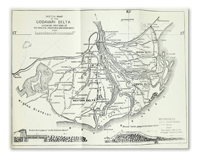
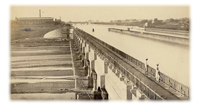
Arthur Cotton’s most ambitious project—the damming of the Godavari River—took eight years to complete. Much of that time, Cotton was ill, but he refused to let his condition hinder the work. The main dam stretched a full two and a quarter miles and was boldly constructed of rubble encased in masonry rather than solid stone. His colleagues mocked him, saying he was “founding the cheapest school of engineering in the world,” but the Company Directors in London were thrilled. The low cost meant the project would yield a 30 percent annual return on capital invested.
It irrigated 364,000 new acres, created 340 miles of navigable channel, protected millions from starvation, and was hailed as “the noblest feat of engineering skill which has yet been accomplished in British India.” Cotton hoped it might foster India’s “appreciation of a Christian Government.”
The Godavari was a triumph, but Cotton had little time to enjoy his success. In 1853, the Governor of Madras appointed an infantry captain to oversee construction works, claiming there were “no capable engineering officers available.” Cotton objected angrily, was accused of insubordination, resigned, and returned to England. Two years later, he came back to India, but after another dispute, he left for good in 1860.
He had earned a knighthood—a modest reward—but as he later told a House of Commons Committee, “I have never asked for an appointment, or for anything else, except to be allowed to irrigate India.”
Even before Cotton retired, other engineers were surpassing his achievements with larger and bolder projects. When the 530-mile Ganges Canal opened in 1854, it was the largest engineering work in the world. It was built by Sir Percy Cautley, another Addiscombe graduate, who was given such a meagre budget that he had to conduct his own surveying. Despite this, he became one of the great Victorian amateur scientists in palaeontology, publishing papers with titles like On a Sivalik Ruminant Allied to the Giraffidae, and eventually donating his entire fossil collection—40 tons—to the British Museum.
 |
|
|
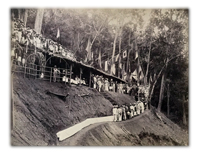
In the spectacular Periyar project in southern India, British engineers outdid themselves. They dammed a river with a flood as powerful as Niagara Falls, drove it through a mountain via a mile-long tunnel, and redirected its flow to the opposite side of the subcontinent. The project took eight years. For half of each year, it rained four out of every five days. Floods repeatedly washed away the foundations. First malaria, then cholera swept through the community of engineers and workers, forcing them to burn one camp and relocate another. Tigers prowled the surrounding jungles. Elephants knocked down tents and houses. Herds of bison stampeded the workmen from their posts. But on October 10, 1895, the Periyar River began flowing toward an ocean it had never seen before, and 100,000 acres of barren land were brought to life.
The engineers would try anything. They carried canals over rivers and, when necessary, rivers over canals. Two rivers cross the Ganges Canal on super-passages, one of them 300 feet wide. Not all these marvels were mechanically created; some were more economical to build using labour-intensive methods. The most important equipment used on the Sirhind Canal in Punjab was three jails, housing convicts who removed 900 million cubic feet of earth—carried in baskets on their heads.
It would be wrong to say that Britain “gave” India water—or anything else. The dams were seen as commercial ventures and, in fact, yielded an average return of 7 to 8 percent, an excellent rate in a period of consistently low interest. Non-paying works were often undertaken because they directly benefited the British. In Lahore, a city “full of stagnant water,” malaria was killing too many British troops. As a result, the streets were paved and a modern drainage system installed, transforming “the most malodorous of native capitals” into a city known for its cleanliness. In building roads—and later railways—a primary objective was to facilitate troop movements.
 |
|
|
The greatest road-building achievement of the British—perhaps the greatest since the Roman Empire—was the Grand Trunk Road, which ran from Calcutta to Delhi and was later extended across Punjab to Peshawar, on the borders of Afghanistan. “The Grand Trunk Road,” wrote Rudyard Kipling, “is a wonderful spectacle; a stately corridor; all India spread out to left and right. It runs straight, bearing, without crowding, India’s traffic for fifteen hundred miles—such a river of life as nowhere else exists in the world.” For the most part, it consisted of three roads: one on either side for heavy carts and a central carriageway for fast traffic, all shaded by four lanes of trees.
It was a mammoth task, taking forty years—on and off—to complete. In one 264-mile stretch between Lahore and Peshawar, engineers had to construct 103 major bridges, 459 smaller ones, tunnel through six mountain chains, and raise immense embankments to carry the road across two vast riverbeds. It was a job for exceptional men—men like Alex Taylor, who, at just 24 years old, was supervising 60,000 labourers across an area four times the size of Scotland. In temperatures hovering around 120 degrees Fahrenheit, he lived on horseback, commuting between the seven separate sections under his control.
At times, it seemed nature resented the engineers’ efforts. James “Buster” Browne, building a bridge on Taylor’s section of the Grand Trunk Road, was awakened one night by shouting. “I saw the river coming down in a huge wave, about 200 feet wide—one wall of roaring water.” His most precious machine, a giant pile-driving engine, broke free from its moorings, “sending coolies in all directions with cut faces and bruised bodies.” Browne and four others plunged into the flood and chained the engine to a ram—a massive piece of iron held between two floating wooden beams. A carpenter swam out with an axe, and together they chopped away at the beams. Five miles downstream, the iron ram, freed of its timbers, finally sank and anchored the pile-driver—just five minutes short of a waterfall.
“The worst part of it was I had to walk five miles without my shoes,” Browne recalled, “in my nightshirt.”
The real turning point in India’s history was the arrival of the railways. “Railways may do for India,” wrote Sir Edwin Arnold in 1865, “what dynasties have never done—what Akbar the Magnificent could not effect by government nor Tipoo Sahib by violence—they may make India a nation.”
Until the Mutiny of 1857, the Indian government showed little interest in railways. Afterwards, it saw them as a military investment. Marching a regiment from Calcutta to Peshawar took six months; by rail, it could be done in 100 hours. “After all,” Arnold wrote, “the first condition of improving India is to hold it.”
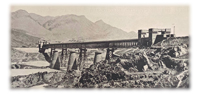
To build railways, the British first had to construct harbours capable of receiving heavy equipment—rails, sleepers, locomotives, and bricks. Madras was an open roadstead where cargo had to be landed through the surf; Calcutta had only a few jetties, located a hundred miles up a river. Skilled labour was virtually non-existent. “Our ballasting and wagon work,” one engineer told a government inquiry, “is conducted and managed by men who never in their lives before saw a wagon. Our bridges, with scarcely an exception, are superintended by men who do not know a brick from a stone.”
Rebels and bandits harried the crews. In 1859, two engineers named Limnell and Evans were surveying for a new railway line when they were ambushed. Evans was decapitated, and Limnell was forced to carry his friend’s head until he collapsed from exhaustion. He too was then murdered. India’s endemic diseases offered no mercy either. That autumn, a cholera epidemic in one district killed 10 percent of the workforce each week. Four thousand died before it subsided.
 |
|
|
And yet, the railways were built. By 1869, 4,000 miles of track were in operation. The social and economic consequences were enormous. Soon, Thomas Cook & Sons were running package pilgrimages to Mecca from India, and branch railways to Hindu shrines were turning a profit. “The chances of a god doing a large and increasing business,” one Englishman observed, “are greatly improved by a railway station.” Internal trade flourished, and with the ability to move goods to ports, India became an exporter. During famines, large quantities of food could be transported quickly. In a vast land without communications, the railway had a unifying, civilizing effect. Matthew Arnold called it “the most persuasive missionary that ever preached in the East.” By 1940, India had 43,000 miles of track.
Not all the great builders of the Empire were engineers in the strict sense. Sir William O’Shaughnessy was a physician, pathologist, Professor of Chemistry, and Deputy Assay-Master to the Mint, who happened to have an insatiable interest in the electric telegraph. His early experiments showed that it simply would not function in India. If fierce winds didn’t blow down the poles, white ants hollowed them out or bandicoots uprooted them. The telegraph’s greatest enemy was the atmosphere itself. Thunderstorms poured such heavy charges of natural energy into the wires that the magnetic polarity of the instruments was deranged.
“I was driven step by step to discard every screw and lever and pivot, and foot of wire, and framework, and dial, without which it was practicable to work,” wrote O’Shaughnessy. “I successively tried and dismissed the English vertical astatic needle telegraph, the American dotter, and several contrivances of my own invention.”
In 1851, “when almost driven to despair,” he devised “the little single-needle horizontal telegraph,” which could operate uninterrupted in all weathers. An experimental line was strung from Calcutta to nearby Diamond Harbour on bamboo posts; these would bend with the wind and withstand hurricanes that destroyed brick houses and drove steamships ashore. Impressed, the Company approved a plan to connect Calcutta, Agra, Bombay, Peshawar, and Madras by wire. O’Shaughnessy was appointed Director-General of Telegraphs, and work began in 1853. He moved quickly. The 800-mile line to Agra was opened within six months. A year later, 3,050 miles were operating, and by 1856 the entire 4,000-mile system was completed—just in time for the Mutiny that began the following year.
“The telegraph,” declared Lord Lawrence, “saved India.” A mutineer on his way to execution agreed, calling it “the wire that strangles us.” News of the uprising was flashed instantly across thousands of miles, allowing the British to concentrate their troops where they were most needed.
During the Mutiny, the man who kept the wires functioning against all odds was Lieutenant Colonel Patrick Stewart, who succeeded O’Shaughnessy as Director-General in 1856. An Addiscombe graduate, Stewart had worked with two other alumni—Cautley on the Ganges Canal and Taylor on the Grand Trunk Road. (He once wrote home that he hoped to finish his section within twelve weeks, though he still had twenty bridges to build.) He loved sport nearly as much as engineering, and the former proved far more dangerous. While shooting in 1853, he was attacked by a wounded tigress who chewed his legs. He survived by playing dead. The following year, he was thrown from his horse at full gallop while chasing bustards and was hospitalized again. In 1856, he was struck by a racket-ball that severed an artery near his left eye.
Thus, he was a battered old man of 24 when he took up the telegraph appointment, but his injuries never slowed his work. He restrung wires as fast as rebels could tear them down. He was the first man to lay telegraph wire under fire, through hostile territory. Wherever the commander pitched his tent, Stewart was nearby, setting up a makeshift station. The Governor-General allowed him to participate in the relief of Lucknow but instructed the commander that Colonel Stewart “was, if possible, not to be killed.”
In 1862, as Britain began laying an international cable system, Stewart was assigned the task of connecting India to Britain by telegraph. He worked westward, laid the cable across the Persian Gulf, and travelled to Turkey to negotiate for that section. There, in 1865, he fell ill and died. In such cases, little attention was paid to the precise cause; it was explanation enough that he was a British engineer working in the tropics. Stewart was 32 years old.
|