

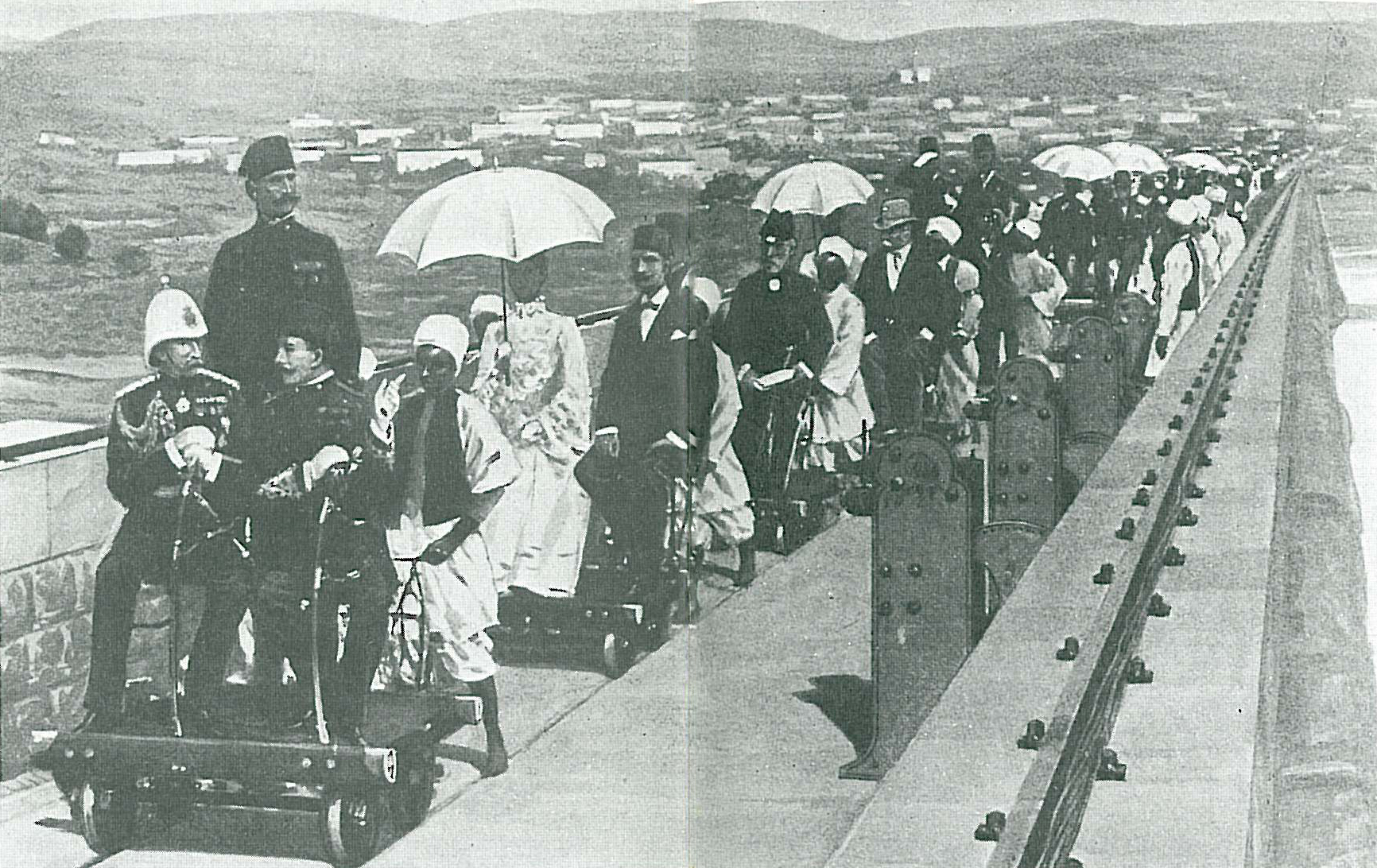
When British and Egyptian dignitaries travelled on inspection trollies across the crest of the newly completed Aswan Dam in 1902, they were witnessing the culmination of one of the most ambitious engineering projects of its age. Stretching for a mile across the Nile at the First Cataract, the dam was designed to regulate the river’s flow and to provide a vast reservoir capable of irrigating millions of acres in Upper Egypt.
The project was directed by Sir William Willcocks, an engineer of the Egyptian Public Works Department, who had already distinguished himself with irrigation schemes in the Delta. The challenge at Aswan was formidable: the Nile at this point rushed through a rocky gorge with a force that had defeated earlier attempts at control. To tame it required a masonry structure of unprecedented scale, built from granite quarried on the site and laid in blocks weighing several tons each.
Construction began in 1898. Thousands of labourers, overseen by British engineers and Egyptian officials, worked in extreme heat to excavate foundations, transport stone, and set the massive blocks in place. Special railways and cranes were erected to move materials, while cofferdams diverted the river in stages so that work could proceed on the dry bed. The dam rose gradually, pier by pier, until the river was spanned by a wall more than 100 feet high and pierced by 180 sluice gates to control the flow.
The logistics of the undertaking were immense. Granite was cut and dressed in the nearby quarries of Aswan, then hauled by rail to the site. Cement, machinery, and ironwork were shipped up the Nile from Alexandria. Engineers had to coordinate the seasonal rise and fall of the river, ensuring that construction advanced during the low‑water months before the annual flood returned. Every stage demanded precision, for a single miscalculation could have endangered the entire structure.
When the dam was completed and the sluices closed, the Nile backed up to form a reservoir stretching 140 miles upstream, submerging ancient temples and villages but providing a steady supply of water for irrigation. The new lake allowed perennial cultivation in regions that had previously depended on the uncertain rhythm of the flood. Cotton, Egypt’s most valuable crop, could now be grown more reliably, and the agricultural economy of Upper Egypt was transformed.
The Aswan Dam was hailed at the time as the “Eighth Wonder of the World.” It was the largest masonry dam yet constructed, and its success demonstrated the capacity of British engineers to impose order on one of the world’s great rivers. In later years the structure would be heightened twice, in 1912 and 1933, to increase its storage capacity, but the original 1902 dam marked the decisive moment when the Nile was first brought under sustained human control.
The inspection by dignitaries on their trollies across the crest symbolised more than ceremony. It was a demonstration of confidence in a structure that had taken four years, countless tons of stone, and the combined effort of engineers, labourers, and administrators to complete. The Aswan Dam stood as a monument to the practical application of engineering skill at the dawn of the twentieth century, a mile‑long wall of granite that reshaped the landscape of Egypt and the course of the Nile itself.

