|
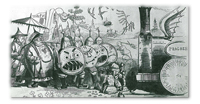
The nineteenth century was an age of iron ambition, when Britain’s engineers carried their skills to every corner of the globe. With rails, telegraphs, dams, and mines, they stitched together an empire not only of territory but of technology. These men were more than builders: they were improvisers, diplomats, and sometimes adventurers, whose bridges spanned continents and whose canals turned famine into harvest. Their work left behind monuments of steel and stone, but also stories of ingenuity, rivalry, and eccentricity that reveal how engineering became one of the empire’s most enduring legacies.
 |
|
|
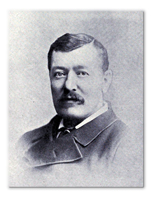
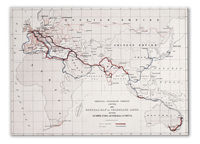
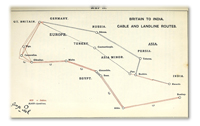
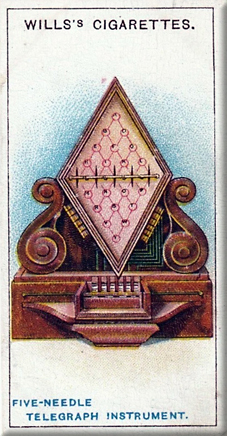
After the death of Lieutenant Colonel Patrick Stewart, the work of laying a telegraph cable from India to Britain was carried on by another Addiscombe graduate, Sir John Underwood Bateman‑Champain, who was then in Tehran negotiating over the construction of the Persian section. The Persians insisted they would build it themselves and would permit only one English officer to enter the country to direct the work. They were enraged at the “cool impudence” of the 30‑year‑old engineer when he arrived with three officers, twelve NCOs, and six civilians. They gave him five months to complete the 1,250‑mile line.
One of his officers was Major William Henry Pierson (also from Addiscombe), an engineer with a reputation as a first‑class chess player, master of the piano, concertina, and cornet, fine actor, excellent Hindustani scholar, outstanding architect, and “a mighty pig‑sticker.” He was also, fortunately, a good shot. One day he was attacked by twenty Persians. His servant was killed almost immediately, but Pierson coolly fought them off single‑handed and was able to proceed, carrying his servant’s body across his horse.
Charmed by Bateman‑Champain, the Shah eventually gave the project his support. When one remote tribe discovered that the insulators on the poles made excellent targets for practice, causing damage that required a month’s work to be redone, he sent down a personal aide with a detachment of soldiers to administer justice. After the offenders were fined, and their village plundered for good measure, there was no more trouble with the line in that area.
Bateman‑Champain could as easily have been a diplomat as an engineer. In St Petersburg, negotiating for the line through Russia, he became a favourite of the Tsar. The concession was granted, and by 1869 messages which had once taken three months were passing from England to India in twelve hours.
The wires with which British engineers were festooning the world created a wealth of new business opportunities, some unusual. Brahmin signal boys on the India‑to‑China telegraph cut a lonely stretch of the line and took the severed ends into a tent, where they had sending and receiving machines. They intercepted and passed on message after message from China until the Hong Kong opium quotations arrived. These they sent privately to an opium speculator who, if the Hong Kong price had risen, would buy up all the stocks in the Indian bazaar. When the signal boys later relayed the quotation on the public wire, he would sell at a large profit. The conspirators were caught and punished, but not before they had built up a tidy stack of rupees out of this particular wonder of modern science.
There was one field in which an engineer, if fortunate, could grow rich: mining. Many of the men who sailed from Great Britain to seek gold in South Africa or copper in Australia were not qualified engineers, of course. Until late in the nineteenth century, mining was less a science than a trade—or a gamble. The miner did not need a degree, but he required a large amount of fortitude.
“No more wretched existence can be imagined than that endured by the early diggers,” wrote an engineer of the South African diamond fields. “A malarial fever raged, water was dear and bad, being carted in barrels from adjacent farms (even after wells were dug, it sold for as much as ten shillings a barrel), and so scarce that I have seen diggers wash in soda water imported 700 miles from Cape Town.”
South Africa owes its position as the world’s richest gold producer to a Glasgow man, J. S. MacArthur. Only three years after the rush began, in 1889, the gold mines of the Rand struck a pyritic zone. This meant trouble. The processing mills were unable to extract enough gold from the pyrites and began closing down. One‑third of the houses in Johannesburg were soon on the market, and the town square was jammed with second‑hand furniture for sale. The boom appeared to be over.
In 1890, MacArthur arrived with his new cyanide process. Watched by the industry’s representatives “to make sure there was no humbug,” he worked with his vats, pipes, and a sample of ore for two days and nights, until a gold ingot emerged from his small portable furnace. He had achieved 98 per cent extraction. The Rand was saved.
Britons were just as important to Australian mining. Cornishmen flocked to the colonies, and their Cornish boilers, Cornish pumping engines, and years of experience transformed the haphazard diggings into a rational industry. They were not always welcomed. At Ballarat, one miner had to defend his steam pump with firearms because others thought it gave him an “unfair” advantage.
Richard Henry Hancock migrated to Australia in 1859 and became manager of its largest mine. His innovations made it the most mechanised and progressive in the industry. “Captain” Hancock became a legend. He was a religious man and a reformer, compelling his illiterate miners to attend four sessions of night school each week before he would allow them to work the following week. Not very popular as a preacher in his church, Hancock had a pulpit built in his office and stood there dictating letters and instructing foremen.
Among such British paragons there were, naturally, some rascals. An engineer from Somerset named William Bailey induced his employer to accept a stranger’s offer of £13,500 for the Mount Egerton Mine, saying that if he himself “had a cart of gold, I would not give more for it.” Then, as soon as the deal went through, a rich vein was “discovered,” and it was revealed that Bailey had a secret partnership with the new owner. In just two and a half months his own share of the profits was £30,000.
Accused of fraud, Bailey was so wounded that he wept, and was known thereafter as “Weeping” Bailey. He won the ensuing lawsuit—as he had “lost” the mine records, nothing could be proved—built a fabulous mansion, and owned racehorses which twice won the Victoria Derby. Twenty years later, however, nemesis struck when a bank he had founded collapsed.
 |
|
|
Often, engineers’ work was the most important event in the contemporary history of the country involved. Such was the case with the Great Nile Dam at Aswan—not the one recently built by engineers from that newer empire, the Soviet Union, but the first, completed in 1902. To gain a foothold in the Nile, William Willcocks tried lowering four‑ton stones into the stream. The water, which he said “rushed at a pace exceeding the fastest University crew,” tumbled them away like children’s bricks. He wired several stones together in a “basket,” but even these could not withstand the torrent. Finally, he lashed them onto railway trucks, fifty tons at a time, and shot the loaded trucks down an incline into the river. They lodged.
When the one‑and‑a‑quarter‑mile‑long dam was finished, it formed a lake stretching the same distance as London to Nottingham, and sufficient to provide the entire population of Great Britain with water for a year. It gave Egypt eight million irrigated acres and made the country wondrously rich for more than a decade—until the population caught up with the improvement. It was called the Eighth Wonder of the World.
Thanks to British engineers, the world was getting a surfeit of Eighth Wonders. Another was the Victoria Bridge, which opened in 1859. Built by Alexander M. Ross, it carried a Canadian railway across the St Lawrence at a point where the river was two miles wide—an alarming distance in those days. American engineers scoffed at Ross’s scheme, saying that blocked ice would topple the bridge in its first winter.
It consisted of a huge rectangular tube resting on masonry piers. The ironwork was manufactured in England in numbered sections and shipped to the assembly site. The Prince of Wales, later Edward VII, opened it, and the ice did not bring it down. In fact, twenty‑five years later other engineers found it perfectly capable of carrying a roadbed twice as wide as the original one. Their only complaint was the durability of Ross’s work; they said it was easier to build the new part than to cut away the old.
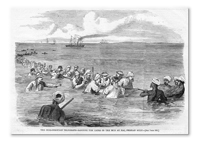
Railways, with their bridges and tunnels, were the British speciality. They built them everywhere they were allowed to—and in some places where they were not. Lord Napier took a complete railway with him when he sailed to invade Ethiopia in 1868. Lord Kitchener, himself an engineer, laid one on his way to Khartoum. Cecil Rhodes’s most pressing imperial dream was to link up with that line from the other end of the continent, a dream he never realised.
 |
|
|
British engineers had a knack for getting around small budgets with ingenious improvisation. Building a railway in New South Wales, John Whitton had to negotiate a steep precipice. Tunnelling would have solved the problem, but the Governor disallowed funds for that, suggesting instead that Whitton lay tracks on the existing highways and have horses pull the railway cars. That, needless to say, was no answer for a railwayman. Instead, he built a gigantic zigzag. The train ran forward down one incline, stopped while a switch was thrown behind it, ran backwards down the next incline, stopped, and so on—traversing three miles of zigzag track to drop 600 feet, a gradient of 1 in 26.
The British railway builder was ubiquitous. Richard Trevithick, in South America on a mining venture, planned a line from Lima to Callao as early as 1817. Had he been able to raise the finance, the world’s first public steam railway would have been built in Peru rather than in Britain. British engineers also tried to obtain permission to build the Trans‑Siberian Railway, but the Russians insisted on waiting until they were capable of doing it themselves.
In China, the British would not take no for an answer. The Chinese government, suspecting—no doubt correctly—that foreign railways would mean more foreign influence, rejected scheme after scheme put forward by British engineers between 1860 and 1875. Finally, one company obtained permission to build a 12‑mile road from Shanghai to Woosung, without specifying what kind of “road” they intended to use to link the two towns.
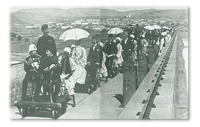
As soon as the “road” was finished in January 1876, Mrs Gabriel James Morrison, the wife of the British engineer in charge, ceremonially laid the first rail upon it. On 14 February, a tiny 22‑hundredweight engine—all the syndicate could afford after paying for the land—made the first steam railway run in China, over three‑quarters of a mile of completed track.
Li Hung Chang, the Imperial governor of the province, heard the news and ordered the British to desist. They agreed not to run the train for a month while he consulted with Peking, but they continued work on the track.
No word came, and the engine resumed operating. The Times reported that “literally thousands” of Chinese turned out to watch every day. On 30 June, with a larger engine diplomatically named Celestial Empire, the first five miles to Kangwan were opened. Three days later, commercial service began: six return journeys daily, all of them packed. Smelling success, the company ordered more cars. Their confidence, however, proved premature.
On 3 August, while travelling at 25 miles an hour, the engine driver saw a man walking on the tracks. He sounded his whistle, and the man moved aside—only to suddenly turn and throw himself in front of the engine. The company suspected the authorities had hired the suicide to discredit the line, but could not prove it. The public grew angry; riots were threatened; and Her Majesty’s Resident Minister, Sir Thomas Wade, ordered the railway closed.
Li Hung Chang, the Governor, declared that permission for a railway had never been given. The company replied that, as China had no railway regulations, no one could say this was not simply a “road.” The dispute was settled by the government purchasing the line in instalments, allowing the company to complete it and operate it in the meantime.
In October 1877, the final payment was made and the Chinese took over the railway, which by then ran all the way to Woosung. They immediately closed it, tore up the tracks, and shipped the rails and engines to Formosa, where they were left to rust on a beach. On the site of the Shanghai Station, they erected a temple to the Queen of Heaven. China, said Li Hung Chang, would have a railway when it was ready to build one for itself. A decade later it did—this time with the help of other British engineers.
As the nineteenth century rolled towards the twentieth, British engineers faced stronger and stronger competition from others, particularly Americans. They had not lost their expertise, but its exclusiveness began to slip as knowledge and technique spread. In Australia, Cornish miners were being replaced by graduates of Australian mining schools and by Americans. Even a London consulting firm sent American engineers to work there; one was Herbert Hoover, later President of the United States.
After J. S. MacArthur tried but failed to solve a copper‑extraction problem in Australia, as he had that of gold in South Africa, an American devised the necessary process. Building a railway in Burma, the British turned to an American firm for the most difficult task: the fantastic Gokteik Viaduct spanning a deep, half‑mile‑wide gorge.
The construction of one of the Empire’s greatest triumphs, the Canadian Pacific Railway—which kept western Canada British and at last provided an “all‑red” route to the Orient—was actually directed by an American engineer, William Van Horne. By then there were Arthur Cottons all over the world, dreaming up canals at breakfast time.
The old pioneer himself was still busy trying to convince the British government to build more dams and canals in India, and fewer railways. The famines which kept recurring there seemed to substantiate his argument. “A patient is bleeding to death,” he wrote in one of his many pamphlets, “and a spectator begins a long discourse on the best mode of treating him so as to restore his strength, but another says, ‘Stop a minute, let us first stay the bleeding.’”
In fact, the bleeding was being stayed. Before Sir Arthur died, India had 55,202 miles of canals; by 1947, 70 million acres were irrigated there—three times as much as in the United States, and a greater area than in any other ten countries combined.
Towards the end of his life, the man most responsible for this great achievement lapsed into another of those nineteenth‑century English roles he performed so well: this time, the old eccentric tinkering with his inventions. His strange experiments with a brass canoe made his family frantic with worry. And on the roads around Woodcot, his home near Dorking, he terrorised passers‑by with a man‑sized tricycle he was trying to perfect.
“Now you just watch me,” he told a stranger, “and tell me how many turns this wheel makes in a minute.” With that, the seventy‑year‑old man wobbled down a hill, struck an embankment, and flew over the handlebars into a hedge. When the concerned stranger ran to his aid, Cotton waved him away. “Look after the machine,” he said. “I can take care of myself.”
His wife begged him to get rid of it, but he replied: “Rome was not built in a day. It will take me a long time to complete my patent brake.” Learning of a missionary who lacked transport, Cotton made the noble sacrifice of sending him the tricycle. The missionary returned it after breaking an arm.
The Cottons managed to die in the same marvellous Victorian style in which they had lived. Galsworthy would have needed only a stenographer. Richard, the brother who became Provost of Worcester College, Oxford, one evening at table “raised his hands in adoration, and in a low voice began to utter sentences of praise and gratitude to God for all His goodness to him during a long life.” He then fell forward, dead, into his dinner.
Sir Arthur himself made his last public utterance in the letter columns of The Times. It was another condemnation of the government for “giving India iron instead of water.” He died a few days later, on 14 June 1899. In his lifetime, he and others like him had linked the past and future with a road of iron. And in a coffin draped with a Union Jack, he was lowered into the soil of a very different world from the one he had been born into—a new world which he and other engineers who sprang from Britain had created.
The story of Britain’s engineers is not only one of iron rails, telegraph wires, and monumental dams, but of the restless imagination that carried them across continents. Their bridges and canals reshaped landscapes, their railways bound together empires, and their experiments—sometimes eccentric, sometimes inspired—left legacies that outlasted the empire itself. Yet behind the feats of engineering were individuals: men of vision, stubbornness, and ingenuity, whose triumphs and failures alike remind us that empire was built as much by spades and rivets as by statesmen. To trace their work is to glimpse a world in transition, where invention and ambition forged connections that still shape the modern age.
|