

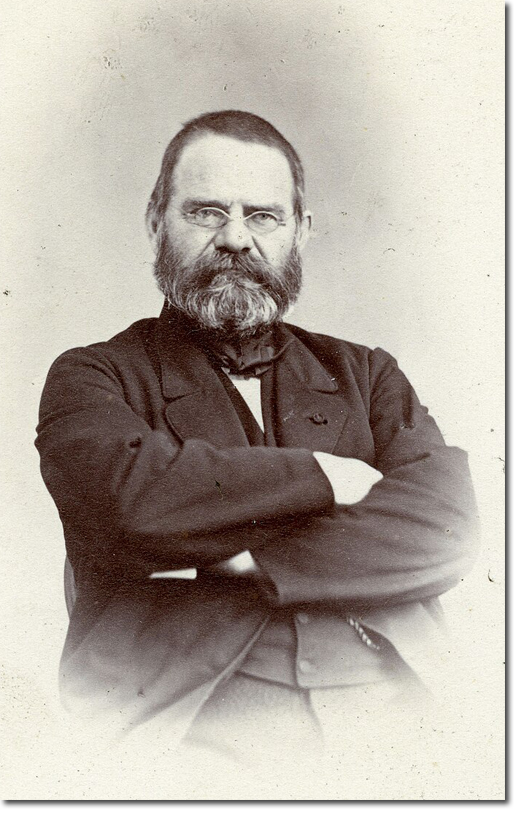
Justus Carl Hasskarl (1811–1894) was a pivotal figure in the botanical strategies of the Dutch Empire, best known for his role in the transfer of cinchona—the source of quinine—from South America to Southeast Asia. As director of the Buitenzorg Gardens in Java, Hasskarl operated at the intersection of scientific exploration and colonial ambition, advancing the Dutch position in the global quinine trade through a combination of fieldwork, covert acquisition, and institutional coordination.
In 1854, Hasskarl travelled under an assumed name to the Caravaya region of Peru and Bolivia, a remote zone in the eastern Andes where cinchona trees grew naturally. His mission was to obtain viable seeds and specimens for cultivation in Java, bypassing the restrictions imposed by the newly independent Andean republics. These states, weakened by postcolonial instability and lacking botanical infrastructure, were unable to prevent the extraction of their most valuable medicinal resource.
Hasskarl’s expedition was part of a broader Dutch strategy to secure a reliable supply of quinine for both commercial and strategic purposes. Malaria posed a serious threat to colonial administrators and military personnel in the tropics, and quinine was the only effective prophylactic and treatment available. By relocating cinchona cultivation to Java, the Dutch aimed to reduce dependence on wild bark harvested in South America and to establish a plantation-based supply chain under their own control.
Although Hasskarl’s initial collections yielded limited results, his efforts laid the groundwork for subsequent Dutch success. In 1865, the Dutch acquired high-yielding Ledger varieties of cinchona from Bolivia through a separate transaction involving an English trader and his Aymara servant. These seeds proved superior in quinine content and became the foundation of Java’s cinchona industry. The Dutch programme of intensive cultivation and scientific management soon outpaced British efforts in India and Ceylon, and by the 1890s, a Dutch cartel dominated the global quinine market.
Hasskarl’s work exemplifies the role of colonial botanic gardens as instruments of imperial science. The Buitenzorg Gardens, under his direction, were not merely sites of botanical research but logistical hubs for crop acclimatisation, varietal selection, and plantation planning. His fieldwork bridged the gap between remote Andean ecosystems and the structured agricultural landscapes of Southeast Asia, converting a wild medicinal tree into a managed commodity.
Beyond cinchona, Hasskarl contributed to the classification and documentation of tropical flora, publishing extensively on the plants of the Dutch East Indies. His collections enriched European herbaria and informed the development of colonial agriculture. Like his counterparts at Kew, Hasskarl operated within a framework that linked botanical knowledge to imperial governance, economic extraction, and public health.
While his name is less widely known than those of Joseph Banks or William Hooker, Hasskarl’s impact on the botanical architecture of empire was substantial. His work helped establish Java as a centre of medicinal plant production, with cinchona plantations supplying quinine to colonial powers across Europe. The strategic value of this transfer was underscored during both world wars, when access to quinine became a matter of military necessity.
Justus Carl Hasskarl’s legacy lies in the integration of field botany with colonial logistics. His expeditions, publications, and institutional leadership contributed to the transformation of tropical plants into imperial assets. The cinchona transfer, in particular, stands as a case study in how botanical science was mobilised to serve the geopolitical and economic interests of empire.

