

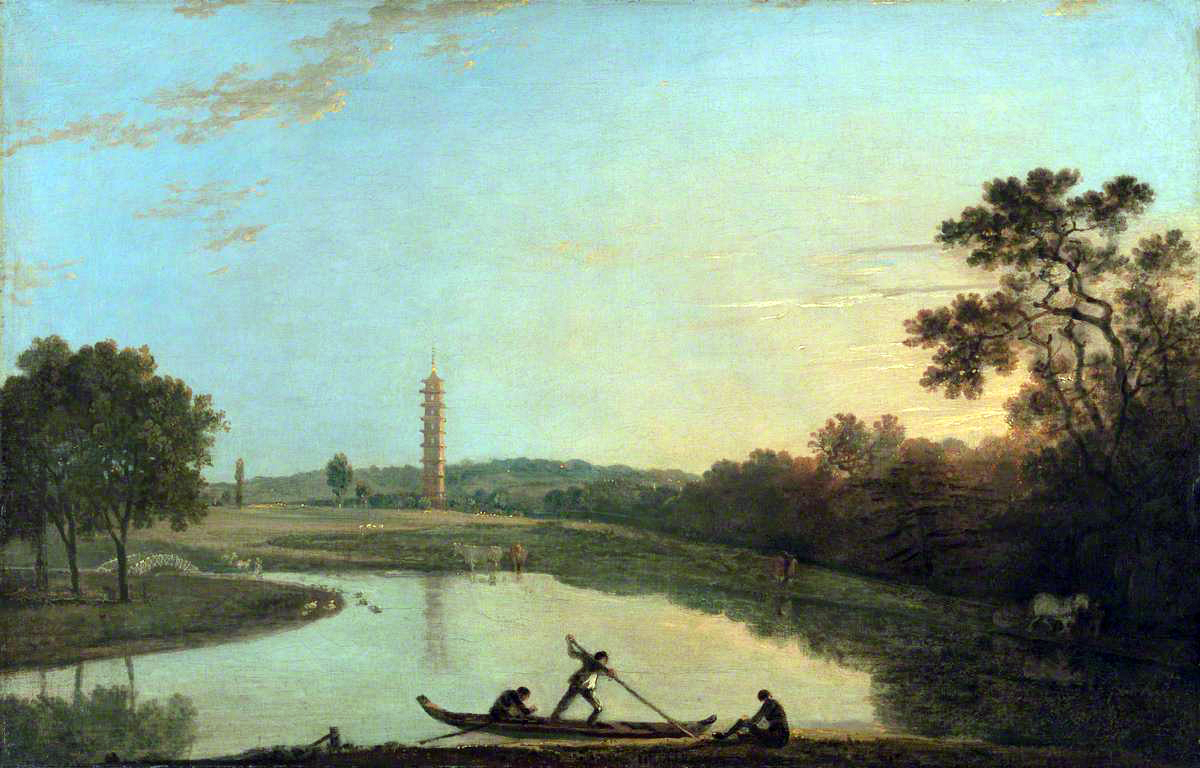
This 1762 painting of Kew Gardens: The Pagoda and Bridge was by Richard Wilson and it shows the international flavour through its Pagoda and bridge.. It was always intended to bring plants from around the world together to experiment and study.
Indeed the Royal Botanic Gardens at Kew played a fundamental role in the development and maintenance of the British Empire’s agricultural and economic infrastructure. From the late eighteenth century onward, Kew evolved from a royal pleasure ground into a scientific institution tasked with identifying, propagating, and distributing useful plants across Britain’s colonial holdings. Its influence extended far beyond horticulture, shaping global commodity flows, labour systems, and the ecological character of entire regions.
Under the leadership of figures such as Sir Joseph Banks and later William J. Hooker, Kew became the nerve centre of a vast botanical network. Collectors were dispatched to every corner of the Empire and beyond, gathering seeds, cuttings, and specimens for study and redistribution. These were cultivated in Kew’s greenhouses, assessed for economic potential, and sent to colonies with compatible climates. The gardens functioned as a clearinghouse for plant intelligence, coordinating transfers between regions as diverse as the Caribbean, South Asia, East Africa, and the Pacific.
Kew’s charter was explicit: to aid the mother country in “everything that is useful in the vegetable kingdom.” This mandate was interpreted broadly. Tea plants were sent from China to India; rubber seeds from Brazil to Ceylon and Malaya; cinchona from the Andes to the hill stations of South Asia; sisal from Mexico to East Africa. Each transfer involved not only botanical expertise but logistical coordination, diplomatic manoeuvring, and—in some cases—subterfuge. Kew’s role was not merely scientific; it was instrumental.
The gardens also served as a publishing hub. Through its Bulletin of Miscellaneous Information and other reports, Kew disseminated cultivation techniques, processing methods, and trade data. These publications were read by colonial administrators, planters, and agronomists, and often contained detailed instructions on how to replicate industries that had previously been monopolised by other powers. In the case of sisal, for example, Kew’s bulletins provided the technical knowledge that enabled German East Africa to establish a thriving fibre industry using plants originally smuggled from Mexico.
Kew’s influence was felt in the structuring of plantation economies. Its guidance shaped the layout of estates, the selection of crop varieties, and the timing of harvests. It advised on pest control, irrigation, and soil management. In many cases, Kew’s recommendations were implemented by colonial botanical gardens—such as those in Peradeniya, Singapore, and Trinidad—which acted as regional outposts of the imperial botanical system.
The partnership between Kew and the British state was mutually reinforcing. Government funding supported botanical exploration and experimentation; Kew, in turn, supplied the Empire with crops that could be cultivated for profit, provision, or strategic advantage. The transfer of cinchona, for instance, was undertaken not to enrich planters but to secure a reliable supply of quinine for British troops and administrators in India. The transfer of rubber was driven by industrial demand, and the movement of breadfruit by the need to feed enslaved labourers in the Caribbean.
Kew’s legacy is visible in the landscapes of former colonies: in the tea terraces of Assam, the rubber estates of Malaya, the cinchona groves of Ceylon, and the sisal fields of Tanzania. It is also present in the institutional structures of botanical science, many of which trace their origins to Kew’s methods and networks. While the gardens were never the sole driver of imperial agriculture, they were a critical node in the system—linking science, commerce, and governance in a coordinated effort to reshape the botanical world.
By the early twentieth century, Kew had become not only a symbol of British scientific achievement but a mechanism of imperial integration. Its archives, seed banks, and correspondence formed the backbone of a global plant economy. The ecological and political consequences of this system—monoculture, labour migration, and resource extraction—continue to shape the postcolonial world. Kew’s contribution to the prosperity of the Empire was substantial, and its role in the transfer and development of useful plants remains one of the most enduring legacies of imperial science.
