

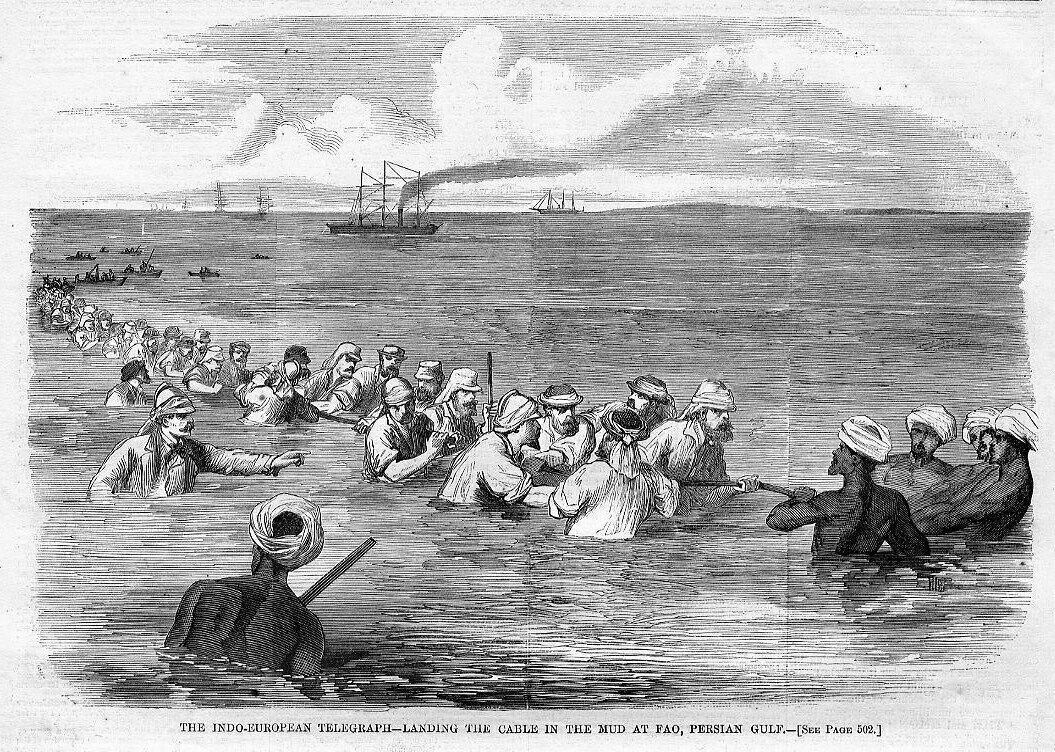
In July 1865, the Illustrated London News published an image of men waist‑deep in the mud at Fao, guiding the heavy telegraph cable ashore from the waiting ships. It was a scene that captured the immense practical challenges of extending the Indo‑European Telegraph through Persia and the Persian Gulf. The project was not simply a matter of engineering design; it demanded careful planning, coordination of fleets, and the physical labour of hundreds of men working in difficult conditions.
The Persian Gulf was the critical junction where submarine cables from the west met the overland lines through Persia. To land a cable at Fao, ships such as the Assaye, Tweed, Marian Moore, Kirkham, Cospatrick, and Amberwitch were deployed. Each vessel had a specific role: some carried the coiled cable in their holds, others provided support, and still others ferried men and equipment to the shore. The cable itself was a massive iron‑sheathed cord, heavy enough to resist abrasion on the seabed, yet flexible enough to be paid out steadily as the ships advanced.
Landing the cable required precision. The ships anchored offshore, and boats carried the end of the line toward the beach. Once in shallow water, men waded in to haul it through the mud, guiding it to the prepared trench where it would be buried and connected to the landline system. Timing was crucial: the work had to be done at the right state of the tide, and the cable had to be handled carefully to avoid kinks or damage. The scene at Fao, with men straining in the heat and mud, was repeated at other landing points along the Gulf.
On land, the practicalities were no less demanding. The Persian section stretched for more than a thousand miles, crossing deserts, mountains, and tribal territories. Poles and insulators had to be transported by camel and cart, erected in remote districts, and maintained against weather and interference. Telegraph stations were built at intervals, staffed by trained operators and engineers who lived in isolated outposts to keep the line functioning. Supplies of food, water, and spare materials had to be organised along the route, creating a logistical chain as complex as the line itself.
The Gulf cable and the Persian landline together formed the vital link between Europe and India. Without the successful landing at Fao and similar operations elsewhere, the Indo‑European Telegraph would have remained a broken chain. The combination of naval coordination, manual labour, and overland engineering turned the vision of a continuous telegraph into reality. By the late 1860s, messages could travel from London to Bombay in hours rather than months, a transformation made possible by the men who wrestled the cable ashore in the mud of the Persian Gulf.

