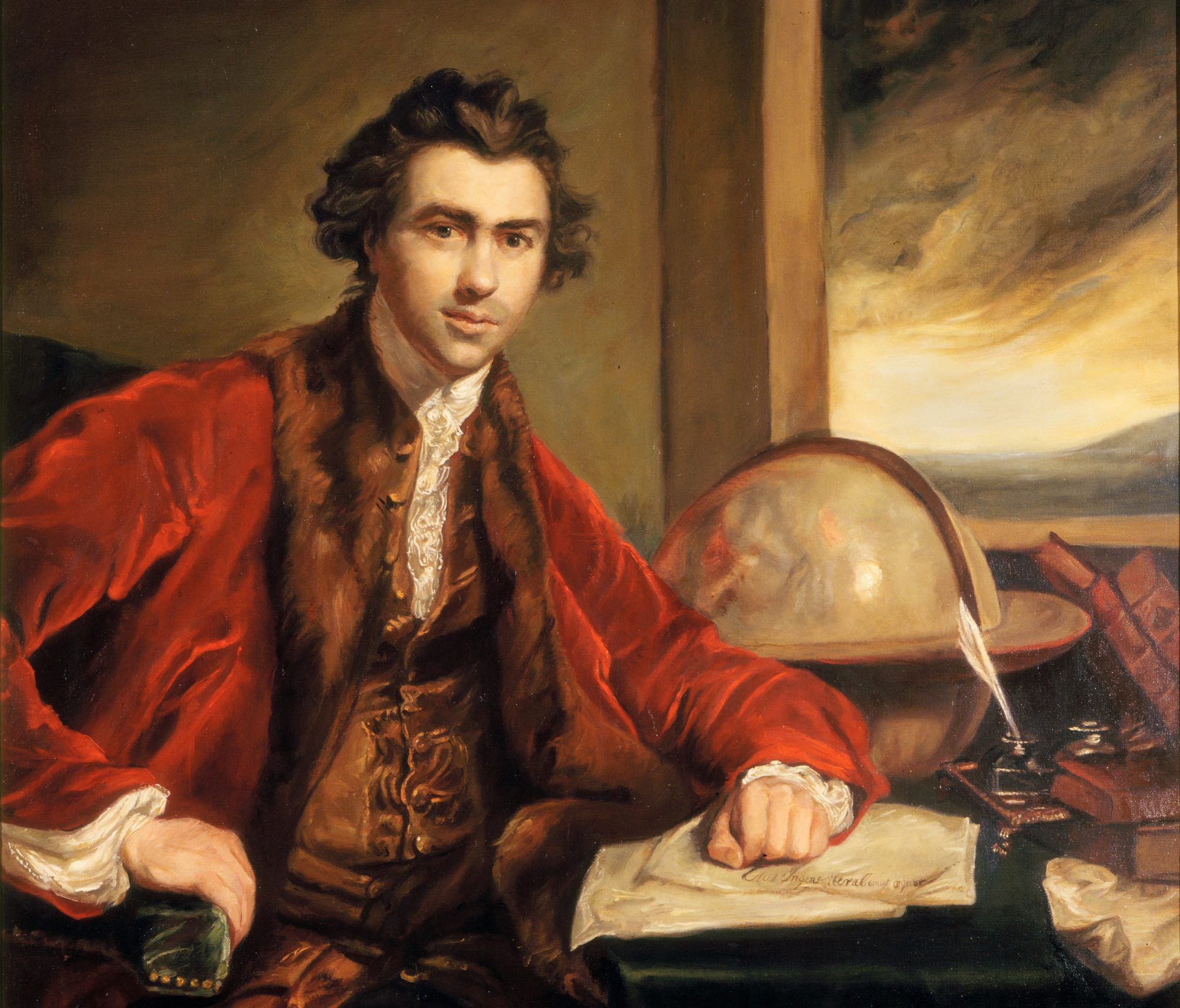
Sir Joseph Banks (1743–1820) played a pivotal role in shaping the botanical infrastructure of the British Empire. As a scientist, administrator, and imperial strategist, Banks helped transform botany from a gentleman’s pursuit into a tool of statecraft, economic development, and colonial expansion. His influence extended across continents, linking scientific institutions with imperial logistics and laying the groundwork for the systematic transfer of useful plants throughout Britain’s global holdings.
Banks first came to prominence as the young botanist aboard Captain Cook’s first voyage (1768–1771), during which he collected and catalogued thousands of plant specimens from South America, Tahiti, New Zealand, and Australia. His participation in the discovery of Botany Bay—named for the abundance of plant life observed there—was emblematic of his approach: combining scientific curiosity with imperial utility. Banks saw botanical exploration not merely as a means of classification, but as a way to identify crops, fibres, and medicines that could be cultivated in colonial settings to benefit the metropole.
Upon his return, Banks became president of the Royal Society and an informal advisor to King George III. He used his influence to promote the settlement of Australia, arguing that its flora and timber resources could support naval provisioning and shipbuilding. He envisioned Norfolk Island as a source of flax and pine for sails and masts, and encouraged the establishment of agricultural colonies that would supply Britain’s expanding maritime presence in the Pacific.
Banks’s most enduring legacy was his transformation of the Royal Botanic Gardens at Kew into a central depot for plant exchange across the Empire. Under his guidance, Kew became a clearinghouse for seeds, saplings, and botanical intelligence. Collectors dispatched from Kew gathered specimens from the Caribbean, Africa, India, Southeast Asia, and the Pacific. These were propagated in Kew’s greenhouses and redistributed to colonies with compatible climates. The gardens served not only as a scientific institution but as a logistical node in the imperial economy.
Banks’s vision was expansive. He supported the transfer of breadfruit from Tahiti to the West Indies to feed enslaved labourers, the introduction of tea cultivation to India, and the movement of spices, fibres, and medicinal plants across colonial boundaries. His correspondence with colonial governors, naval officers, and fellow botanists reveals a network of exchange that blended scientific inquiry with commercial ambition. Banks understood that plants could be instruments of imperial integration—standardising crops, stabilising food supplies, and generating export commodities.
While Banks did not personally engage in the covert operations that characterised later plant transfers—such as the smuggling of cinchona or rubber—he laid the institutional and ideological foundations for such efforts. His emphasis on botanical utility, climate matching, and coordinated distribution shaped the practices of Kew Gardens and its successors. The nineteenth-century expeditions that moved tea, quinine, and rubber across continents were built on the logistical frameworks and imperial ethos that Banks helped establish.
By the time of his death in 1820, Banks had embedded botany within the machinery of empire. His legacy was not confined to scientific nomenclature or herbarium sheets, but lived on in the plantations, gardens, and agricultural systems that sustained Britain’s global reach. The partnership between colonising governments and botanical institutions—so central to the imperial economy—owed much to Banks’s vision of science in service to empire.
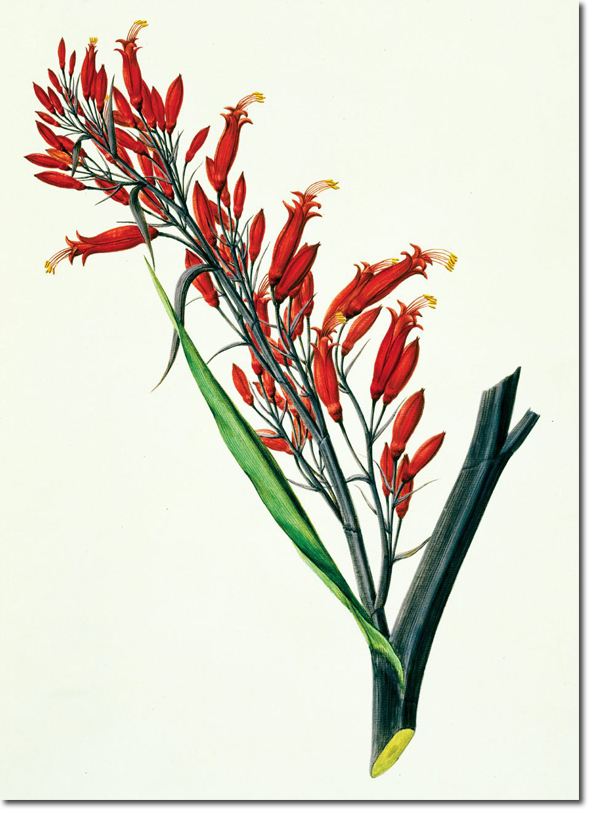
Below you can see a botanical illustration depicting a flowering plant characterised by vibrant red tubular blossoms arranged along a central, upright stem. Each flower features a yellow-tipped stamen extending from its opening, suggesting adaptations for pollination by long-tongued insects or birds. The leaves are lanceolate, smooth-textured, and green, positioned alternately along the stem. The stem itself appears thick and sturdy, with a cut end revealing internal vascular structure. Rendered with precision and clarity, the image reflects the conventions of late eighteenth- and early nineteenth-century botanical art, likely produced for scientific documentation or educational dissemination. Its stylistic and technical qualities are consistent with illustrations commissioned or collected under the patronage of Sir Joseph Banks, whose expeditions and institutional influence helped establish the visual and taxonomic foundations of imperial botany.