

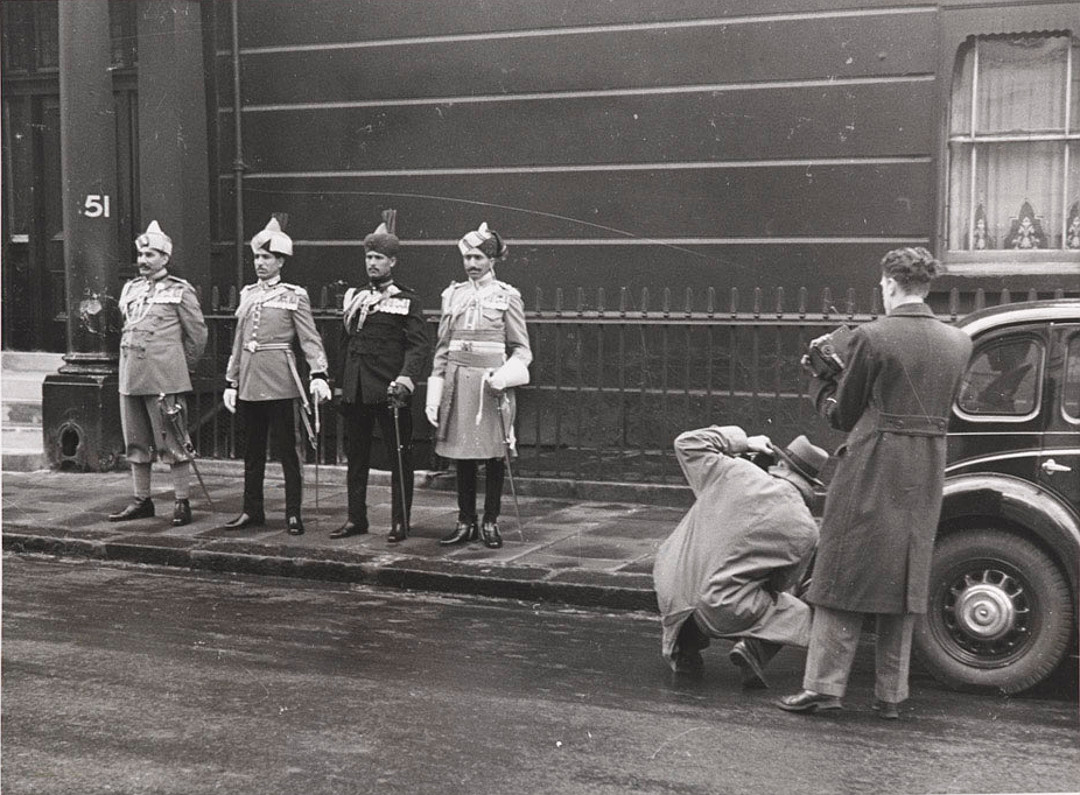
The last year that Indian Orderly officers attended His Majesty the King was 1939, on the eve of the Second World War. As with World War One, the annual voyage from India had to be suspended after that, but unlike 1919, the tradition was not resumed after the war. Indian Independence in 1947 meant that the regiments administered by Britain were in future to be part of the armies of India and Pakistan. However, Queen Elizabeth did institute the annual attendance of two Gurkha officers from the British Army for the court season.
The four Indian officers posed for photographers in St George’s Road, Pimlico, near their quarters at no.49, before they visited Lord Zetland, Secretary of State for India in May. The photo is courtesy of the National Army Museum. The four Indian officers demonstrate the diversity of uniforms ranging between drab khaki, scarlet, rifle green and French grey. The British officer in charge of the King’s Indian Orderlies, Major Birdwood, is not in the photo.
Left: Subadar-Major Sardar Khan, Sardar Bahadur OBI IOM, 2nd Battalion 8th Punjab Regiment. This was the 90th Punjabis. Before 1903 they were the 30th Infantry (5th Burma Battalion). They served in Mesopotamia in the First World War and in Burma in the Second World War. The uniform in 1914 was khaki and black but after the amalgamation of the six Punjabi regiments they wore drab khaki uniforms with blue facings, as worn by Subadar-Major Sardar Khan.
Second left: Subadar-Major Taj Din, Bahadur OBI IDSM, Royal Bombay Sappers and Miners. The Sappers and Miners in France accomplished engineering tasks despite a deficiency in equipment, transport and weapons. They also fought in the trenches so that in 1914 the Bombay companies lost all their officers. In 1921 the 3rd Bombay Sappers and Miners were granted ‘Royal’ status. Up until 1931 the sappers were commanded by British RE officers, but Indian officer cadets were trained at RMA Woolwich from that year. Officer training was started at Dehra Dun in 1932. In the Second World War the Bombay Sappers lost six field units in Malaya when they were captured by the Japanese. They became the Royal Indian Engineers after the war, and in 1947 the classes were split up into the Indian and Pakistan armies.
Third left: Subadar-Major Rahim Ali, Bahadur OBI IOM, 5th Battalion (Napier’s) 6th Rajputana Rifles. This regiment comprised the 104th Wellesley’s, 120th, 122nd, 123rd Outram’s, 125th Napier’s and the 13th Rajputs (Shekhawati). The 5th Battalion (Napier’s) served in France, Egypt and Mesopotamia. Rahim Ali was a Colour-Havildar in the 125th Napier’s Rifles when he was awarded the Indian Order of Merit for bravery in Egypt.
Right: Risaldar Ahmed Khan, 7th Light Cavalry. The only representative of the Indian cavalry in 1939 was this officer, the most junior of the group. The 7th Cavalry had remained unchanged in the reorganisation of 1921. They were the 28th Light Cavalry from 1903 to 1922 and the 3rd Madras Lancers before 1903. They served in Persia and, after the Russian Revolution, finished up fighting the Bolsheviks. In 1923 the 7th Light Cavalry was one of the first regiments to be Indianised so that the British officers were all replaced by Indians. The uniform worn in this photo was the dress kurta; French grey with buff facings and silver lace.
The British officer in charge of the King’s Indian Orderlies for this year was Major The Honourable Christopher Bromhead Birdwood MVO, Probyn’s Horse (5th King Edward VII’s Own Lancers). The 11th KEO Lancers (Probyn’s Horse) and the 12th Cavalry formed this regiment in 1922 (‘VII’ was added in 1937 after the abdication of Edward VIII). The uniform was dark blue with scarlet facings.
Christopher Bromhead Birdwood was born on 22 May 1899, the son of Field Marshal Lord Birdwood. His mother was Janetta Hope Gonville Bromhead, niece of Gonville Bromhead VC, commander at Rorke’s Drift. He entered the army in December 1917 and served in France as ADC to his famous father who commanded the Australian Corps. In 1919 Christopher was posted to the 11th King Edward’s Own Lancers and served in the Waziristan campaign. In 1920 he was attached to the 76th Punjabis, returning to his regiment the next year. He was promoted to captain on 21 December 1921 and attached to other units for campaigns on the Northwest Frontier from 1923–25. In May 1929 he was once more ADC to his father who was by then Commander-in-Chief in India. He was promoted to major on 21 December 1935, and fought in Waziristan in 1936–37, appointed squadron commander in Probyn’s Horse in January 1938. He served with his regiment in the Second World War and rose to the rank of lieutenant-colonel in December 1943. He retired due to ill-health on 4 June 1945. He was married twice. He inherited the title 2nd Baron Birdwood in May 1951 and made speeches in the House of Lords, expressing concern about the spread of Communism, and wrote several books. He died on 5 January 1962.

