

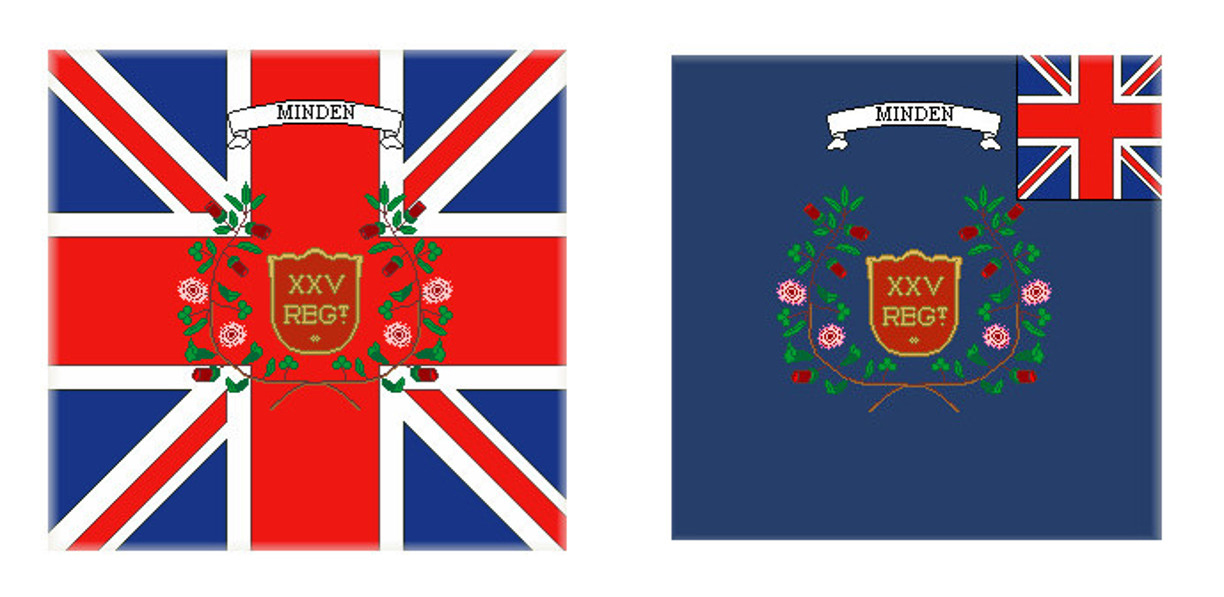
The Act of Union of the Kingdom of Great Britain with Ireland was brought about in 1800 and came into effect on 1 January 1801. This meant that the Union flag incorporated the red Saltire of St Patrick to combine with the red Cross of St George and the white on blue Saltire of St Andrew.
The regimental number XXV was central to both Colours, inside a shield, and surrounded by the Union wreath made up of roses, thistles and shamrocks. Both the King’s Colour, on the left, and the Regimental Colour, on the right, have a single battle honour emblazoned, MINDEN. This battle was fought on 1 Aug 1759, a most important date for the Regiment. But the battle honour, their first, was not conferred on the regiment until 1 January 1801.
The Regimental Colour is blue. It was changed in 1805 when the Regiment became The 25th (The King’s Own Borderers) Regiment of Foot, a title conferred by King George III. The 25th had previously been titled The 25th (Sussex) Regiment of Foot, a title foisted on them in 1782.
For the whole of the 18th century the 25th had carried a Regimental Colour of deep yellow, but from 1805 the 25th was a ‘Royal’ Regiment and entitled to blue facings on their uniforms, to replace the yellow, and a blue Regimental Colour.
There is a paragraph in Records and Badges of the British Army by Chichester and Burges-Short (1900), following their contemporary description of the Regimental Colour:
‘The White Horse badge, which appears to have been conferred on the regiment in common with others engaged in Scotland soon after the accession of the House of Brunswick, was displayed in three corners of the regimental colours previous to 1805.’
The White horse features on later Colours but there is no other evidence that it was emblazoned on 18th century Colours. The reference to Brunswick must be incorrect. The Arms of Hanover incorporated the two yellow lions of Brunswick (Braunschweig), the blue lion of Lüneburg and the White Horse of Saxony. The Hanoverian Kings of Great Britain used the White Horse as their military symbol.
The illustrations are from the Flying Squirrel Entertainment website. The small Union in the upper canton is normally viewed on the top left corner, but when seen from the other side the Colour had the same central device but the small Union would be to the right.

