

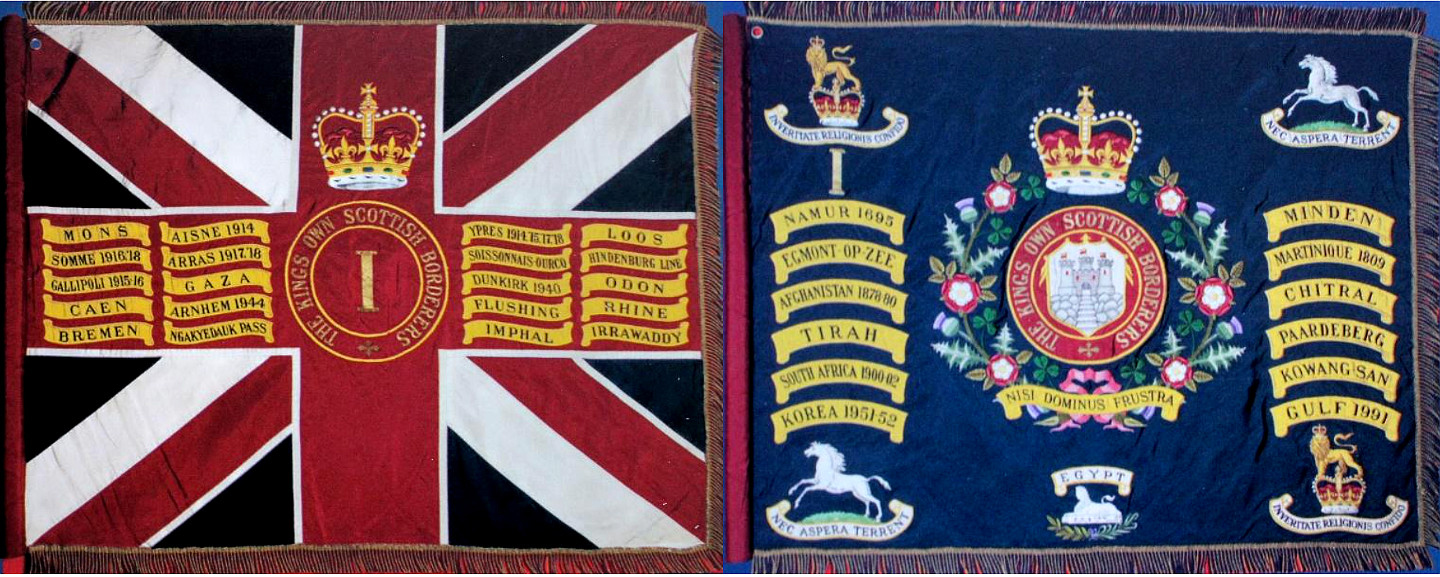
The Queen’s Colour is the Union throughout with the Regimental title on a circle in the centre. The Roman numeral in the centre signified the 1st Battalion despite the fact that there had been only one battalion since 1948. Queen Elizabeth’s crown is above the circle. The 20 battle honours are a selected representation of the Regiment’s active service throughout two world Wars; 66 honours for WW1 and 43 for WW2.
To the left of the Colour there are six honours for WW1:
MONS
AISNE 1914
SOMME 1916,18
ARRAS 1917,18
GALLIPOLI 1915-16
GAZA
And four honours for WW2:
CAEN
ARNHEM 1944
BREMEN
NGAKYEDAUK PASS
To the right of the Colour there are four honours for WW1:
YPRES 1914,15,17,18
LOOS
SOISSONNAIS-OURCQ
HINDENBURG LINE
And six honours for WW2:
DUNKIRK 1940
ODON
FLUSHING
RHINE
IMPHAL
IRRAWADDY
The Regimental Colour has the Royal Crest in the upper canton and lower opposite corner, with the Regimental motto IN VERITATE RELIGIONIS CONFIDO. Below the upper Royal Crest is the Roman Numeral for the 1st Battalion. The other two corners are occupied by the White Horse of Hanover and the Hanoverian motto NEC ASPERA TERRENT.
The centre of the Colour has the Arms of the City of Edinburgh shown as the castle on rocks with a staircase. The motto of the City is on a scroll below the circle NISI DOMINUS FRUSTRA. The Arms motif is surrounded by the Regimental Title and the whole surrounded by a Union wreath of roses, thistles and shamrocks. Queen Elizabeth’s crown is above the wreath.
The battle honours are the same as on the 1975 Colours with the addition of GULF 1991. Ten of the battle honours represent the regiment’s service over the 207 years between NAMUR 1695 and SOUTH AFRICA 1900-02. Two of the battle honours for the Korean War were added in 1952; KOWANG-SAN and KOREA 1951-52. The last battle honour to be added was GULF 1991 so that six honours were placed each side of the centre and one, EGYPT and the Sphinx retained the place at the lower central part of the Colour.

