

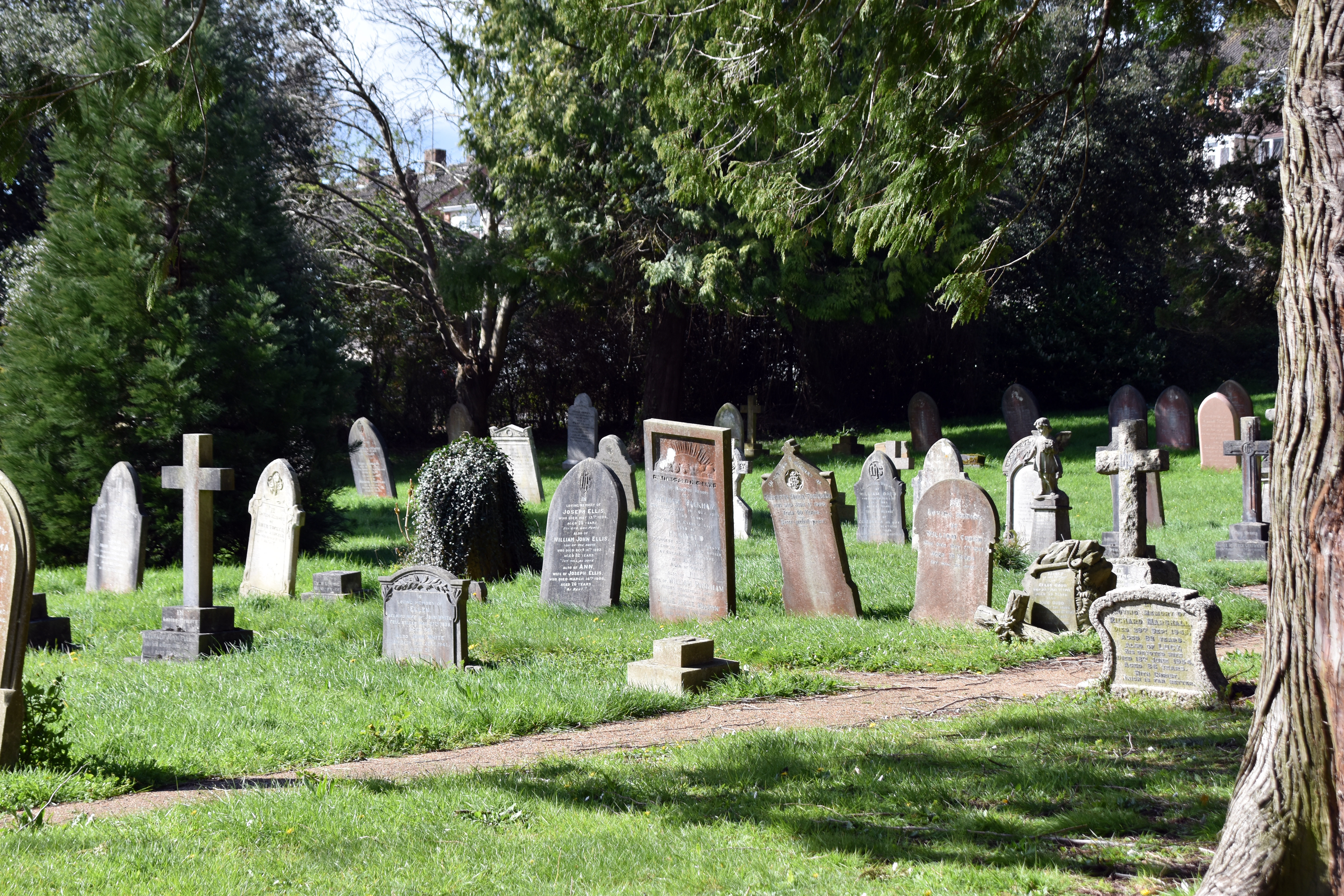
Exwick Cemetery was opened in 1877 on a rolling hillside of deep red soils, then surrounded by open fields on the western edge of Exeter. Conceived as a garden cemetery, it lay beyond the built-up Cowick Street area and was very much a product of Victorian public health reform, moving burials away from crowded churchyards and closer-packed urban streets.
From the outset it provided for different strands of Christian worship. A Church of England chapel and a Nonconformist chapel were built side by side, of similar design, and approached by a carriage drive between an avenue of trees. The original grounds were relatively compact and carefully planted with nursery-grown exotics, reflecting contemporary ideas about ordered, landscaped burial grounds that combined utility with a degree of ornament.
As Exeter expanded westwards, repeated extensions carried the cemetery out across the former fields and up the steep hillside towards Redhills. The burial ground gradually grew from a small, self-contained enclosure into a much larger site stepping up the slope, with new sections added as demand increased. In recent times, part of the cemetery has been allowed to develop as woodland, softening the older, more formal layout, while modern housing now surrounds the site on most sides. What began as a cemetery in open country is today embedded within the suburbs.
The planting has evolved with the cemetery. Some of the original trees have now reached great age, including a magnificent Cedar of Lebanon and an entrance avenue of Arborvitae that still marks the main approach. These are complemented by later introductions such as Copper Beech, Ginkgo, Tulip Tree and White Poplar. Along one boundary stands an oak of considerable age and girth, a rare survivor from the fields and hedgerows that once characterised this part of Exeter before the cemetery and housing estates were laid out.
Within the grounds are memorials that reflect both local history and wider imperial and military connections. Among them is the grave of Frederick John Widgery, the Exeter artist and former Mayor of the city; a memorial to Frank Shooter, remembered for saving many lives at the Head Weir Bathing Place in the days when swimming in the River Exe was a regular pastime; and monuments to families associated with the St Thomas plant nurseries. Many other stones record the lives of tradespeople, soldiers, mariners and families whose stories together form a cross-section of Exeter’s past.
Today Exwick Cemetery remains in use and continues to function as both a burial ground and a green space. Its mixture of Victorian layout, mature trees, later plantings and encircling housing makes it a clear example of how a nineteenth-century garden cemetery has adapted to changing patterns of urban growth while still preserving traces of the landscape that preceded it.


