

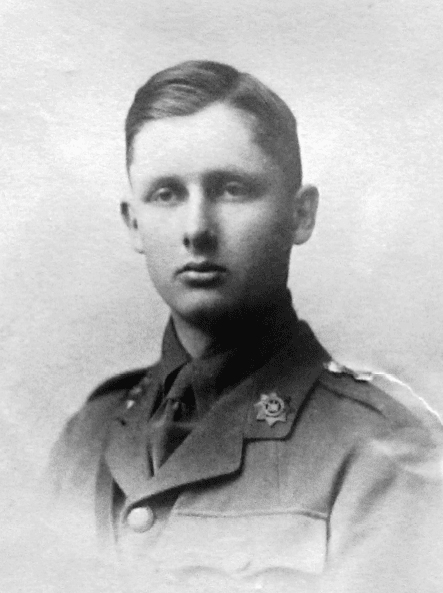
Paul Francis William Studholme was born on 31 May 1898 at Kakahu South, Canterbury, New Zealand, the eldest child of William Paul Studholme and his wife Mabel (née Gray). The family came to Britain in 1906 and settled at Perridge House (below) to the west of Ide, where at the time of the 1911 Census they were living with eight servants, including a governess. His father was one of the five children of John Studholme [II], an Oxford graduate who, together with his brothers, had established large estates in New Zealand during the mid‑nineteenth century, including the 98,500‑acre Te Waimate property. The family name survives in the small town of Studholme near Waimate. William Paul had studied Law at Magdalen, been called to the Bar, and returned to New Zealand to manage the family estate. He became sole owner of the 12,000‑acre Kakahu estate, capable of sustaining 14–15,000 sheep, before selling it during the Boer War and retiring to Britain. He arrived with his family aboard the SS Tongariro in June 1906 and lived the rest of his life at Perridge House, describing himself as a “Gentleman of Independent Means” and serving as Devon’s High Sheriff in 1936.
Paul was the eldest of four children: Henry Gray, later CVO and Conservative MP for Tavistock; Eleanor Elizabeth, later Brown; and John Wyndham, later Commander RN, DSC, who commanded HMS Seawolf during the early part of the Second World War. Paul was educated at Cordwalles Preparatory School, Maidenhead, from 1908 to 1911, and then at Eton College from 1911 to 1916, where he became Head of his House. His Eton obituarist described him as quiet and retiring, reliable in both work and play, fond of rowing, and someone whose character developed further at Sandhurst and at the front, where “without losing his quiet charm, he became more alert to his surroundings, and claimed a larger share of them”. He was accepted by Magdalen College in 1916 but did not matriculate. After his death, his father wrote to President Warren that Paul had been “so very pleased at having matriculated at Magdalen & was looking forward to his life there after the war so very much”, adding that “in his steady quiet ways he would have done credit to the College”.
Studholme, who was 5 foot 11 inches tall and had been a Corporal in the Eton Officers’ Training Corps, trained at Sandhurst and passed out sixth. He was gazetted Second Lieutenant in the 1st Battalion, Devonshire Regiment, on 1 May 1917, arrived in France on 3 July, and joined the Battalion in the trenches near Arras. In late September the Battalion moved north towards the Ypres Salient for the next phase of the Third Battle of Ypres. On 3 October it took up assembly positions near Sanctuary Wood in preparation for the attack on Passchendaele Ridge on 4 October, later known as the Battle of Broodseinde. Before the attack had fully begun, the Battalion’s Commanding Officer and Adjutant were killed by heavy shell‑fire, and it seems that Paul died in the same bombardment, aged nineteen. His father later wrote that he believed Paul had been killed by concussion: “when found there was no wound on him but he was quite dead in a shell hole”.
His Eton obituarist recorded that “his body was found later, lying untouched where he had fallen from shell‑concussion”, adding, with a quotation from Marcus Aurelius, that “in life three acts are often all the play”. His brother Henry wrote in his diary of the moment he learned the news, calling it “a most bitter blow”, and recalling a recent letter from Paul in which he had joked that he might “get a permanent job… out here pushing daisies”. The Battalion held its positions through 5 October and withdrew the following day, having suffered heavy casualties. Paul was initially buried near where he fell, about 650 yards north of Gheluvelt. In July 1919 his body was moved to Hooge Crater Cemetery, Grave X.G.12, where the inscription reads “Semper paratus” (“always prepared”).


