| In the era of the Pharaohs, Jehovah
had visited ten plagues upon the
land of Egypt. But ever since the
Pharaonic civilization had vanished
Egypt had suffered, almost without
intermission, an eleventh plague, vicious
government at the hands of foreign
aggressors. Down the centuries Arabs,
Mamelukes and Turks had successively
conquered her, exploited her, lived in
extravagance on the industrious misery
of her peasant fellaheen.
Britain had no wish to join the long
line of Egypt's alien conquerors. Her
vital lifeline to India was the three month
route round the Cape of Good
Hope. The Mediterranean, with Egypt at
its far south-eastern corner, was of relatively
minor concern.
But when Napoleon invaded Egypt in
1798, British officials were horrified by
the nightmarish possibility that he might
make for India - only recently secured
from the French - by the overland route
through the Middle East. Egypt thus
acquired a strategic significance for
Britain which she was not to lose for more
than 150 years - an interest that,
accentuated by the building of the Suez
Canal in 1869, led Britain irrevocably,
and often unwillingly, ever deeper into
the mire of Egypt's administration.
The opening of the 19th Century saw a
new, preventive British interest in the
Mediterranean. The British reaction to
Napoleon's invasion had been violent:
Nelson had shot the French fleet to shreds
in Aboukir Bay. But in British eyes, there
remained a long-term threat to the route
to India. The lands around the eastern
Mediterranean, including Egypt, formed
part of the moribund Ottoman Empire.
Should it collapse, Russia might sweep
southwards or France eastwards, swallowing
as much as possible of the Arab world,
including Egypt, and thus imperilling
India. Accordingly, Gibraltar and Malta
became first-line naval bases and Britain
prepared to prop up the flagging Turkish
regime. At the same time she let it be
known that she would tolerate no rival
foreign presence in Turkish Egypt.
Napoleon's incursion, however, had
impelled Egypt along a new course. From
the turmoil created by this first glimpse
of European methods and manners,
sprang a new house of rulers, who set themselves to bridge the gulf between
their backward Turkish colony and
modern Europe.
The first of these rulers - or Viceroys
of the Sultan - was Mohammed Ali, the .
"Father of Modern Egypt." A formidable,
colourful scoundrel who had been
an Albanian soldier in the Turkish
service, he clamped a ruthless dictatorship
on the country, started industries,
introduced the large-scale cultivation of
long-staple cotton and began a system of
perennial irrigation. Above all, he built
up a massive army which he sent ravaging
through Anatolia and Greece to the
threshold of Constantinople; in the process,
he won for himself a measure of
autonomy from the Sultan of Turkey,
who remained his overlord, though his
control was only nominal.
Soon afterwards Mohammed Ali
allowed a British officer, Lieutenant
Waghorn, to organize an Overland Route
between the Mediterranean and the Red
Sea. Steamships started to voyage regularly
from London to Alexandria, and
from Suez to Bombay, with Waghorn's
river boats and pack-animals bridging
the land barrier between and cutting the
journey to India to one month.
Bv the time of Mohammed Ali's death
in 1849 Britain was well content with her
position in the Mediterranean: she had
provided for the landward defence of her
eastern empire and she had gained a
second route to India.
But in 1854, Said, a member of
Mohammed Ali's house, succeeded to the
viceregal throne. Enormous and obese,
extravagant and jovial, he too was a
despot; his ideas, however, were well
intentioned and even liberal. His permissive
good nature opened the country to an
influx of privileged European residents traders,
technicians, experts and promoters
of all sorts.
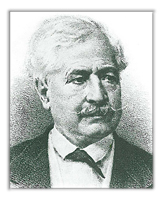
Among the latter was Ferdinand de
Lesseps, a Frenchman obsessed with a
dream: a canal piercing the Isthmus of
Suez, and providing a new sea-route from
the Western Hemisphere to the Eastern,
thus shortening the route to India.
De Lesseps had no official standing
with the French government. He was
neither engineer nor financier. But he was
a man of extraordinary persuasiveness
and perseverance, and a personal friend of
the new Viceroy. One evening, during
some army manoeuvres in the desert at
which Said was present, de Lesseps talked him into giving permission for the realization
of his idea. And he further persuaded
the Viceroy into granting him absurdly
generous concessions: large areas of land
adjacent to the proposed route of his
canal together with handsome mineral
rights, and free forced labour for the
construction. These promises secured, the
dynamic Frenchman rushed to arid fro
between Cairo and the capitals of Europe,
expounding his vision, exorcizing doubts,
mobilizing support for his projected Suez
Canal Company.
From the start, official Britain was
opposed to the whole project. In the first
place, London was entirely satisfied with
the Cape and Overland routes to India.
And in the second, though de Lesseps was
a lone wolf, he was French: inevitably his
enterprise would once again place an
ominous, French, presence between
England and her empire in the East. "At
present India is unattackable," the
Foreign Office warned. "It will no longer
be so when Bombay is only 4,600 miles
from Marseilles [by sea]." But as at this
moment Britain and France, in one of
their rare alliances, were fighting side by
side to contain Russia in the Crimea,
Britain's efforts to scotch the Canal
scheme could only be of a limited and
indirect character.
The project itself staggered through a
series of financial crises. The French
subscribers to the Canal's shares were not
eager to pay up. The Ottoman Empire
failed to take up any of the shares reserved
for it, a problem which de Lesseps solved
by simply transferring the Ottoman
shares to Said's account.
To complicate matters further, Said,
having accepted the added liability for
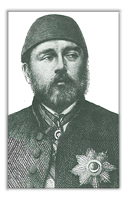
Egypt, died. His successor, Ismail, was
far less pliable. He was an ugly, squat
man, with a defective eye and tufts of red
hair sprouting from his face, and his ungainly
exterior concealed something of
the unshakable self-confidence of his
grandfather, Mohammed Ali. One of his
first acts was to demand the revision of
Said's concessions regarding land, mineral
rights, and slave labour. Construction
ceased. London was jubilant.
But it was not the end. The Company
claimed compensation, and the arbitrator
- Napoleon Ill, Emperor of the French - awarded
it £3 million, or nearly half the original capital. In addition, Ismail agreed
to pay £3 million more, from the future
dividends to be realized on his own
shares - in return for a promise of immunity
from further claims. Egypt had
thus shouldered almost the whole cost of
the Canal, signed away her dividends, and
was left with nothing. And it was not
Ismail, but Egypt herself - her patient,
already over-taxed fellaheen - who would
ultimately have to find the money.
As if this monstrous burden was not
enough, when the arduous, ten-year task
of building the canal was at last finished,
de Lesseps spent another £2 million on
the ceremonies that marked the completion
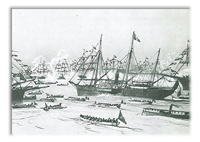
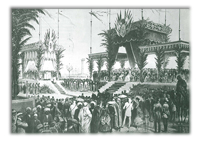
and opening of the Canal. On
November 17, 1869, the French imperial
yacht, with the Empress Eugenie waving
from the bridge, led a procession of 51
ships from Port Said to Suez and back, in
one of the most grandiose spectacles
ever staged.
The Canal was only the first stage on
Ismail's road to ruin. By means of
enormous' bribes he carried on his forebears'
struggle against the Sultan, winning
among other rights the title of
"Khedive," or Prince: this alone cost him
a million pounds in cash and a gold dinner
service set with gems for the Sultan's
table. Still convinced of his astute business
sense, he spent money like water on
his own lavish living, and on public works
of every kind: palaces, harbours, bridges,
railways, ships. Bricks and mortar, metal and glass, burgeoned into new buildings
in ever growing cities.
Word spread that Egypt was a splendid
field for bankers. And no wonder - for
the finance came from Europe, at shocking
prices. Loan followed loan from
Goschen's, Oppenheim's, Bischofsheim's,
Rothschild's. At last in 1875, as the net of
foreign bankers, contractors and agents
began to tighten, Ismail had to fall back
on his only real assets to raise cash for the
interest on his loans: he let it be known
that his Canal shares were for sale.
It was then that Disraeli stepped in.
Already the Canal was changing the
pattern of ocean trade; already British
shipping was its major user. It was clear
that having failed to prevent the Canal,
Britain must aim to control it.
Parliament was not in session. The only
means of obtaining the money was by a
temporary loan. And the only bank able
to advance £4 million quickly was the
house of Rothschild.
Montague Carry, Disraeli's private
secretary, gave a dramatic account of how
he sped to the City and laid the request
before Baron Lionel de Rothschild:
''When do you want it?"
"Tomorrow."
"What is your security?"
"The British Government"
Rothschild took a muscatel grape
from a bunch at his side, ate it, and carefully
removed the skin from his mouth.
"You shall have it."
Corry's story probably lost nothing in
the telling. But within a few days of the
interview Britain stood possessed of
44 per cent of the capital of the Suez
Canal Company. It was the point of no
return on the road that was leading to her
direct intervention first in Egypt, then
in the Sudan: an intervention forced upon
her by the politics of Empire and the
facts of imperial geography.
The £4 million Disraeli paid for Ismail's
shares quickly melted away. The Egyptian
foreign debt was soaring to the £100
million mark. All along the Nile the
kurbash - the rhinoceros-hide lash that
had always been the tax-collector's pitiless
instrument of extraction - was busier
than ever. But no more could be flogged
from the fellaheen. In April, 1876 debt
payments were postponed for the first
time. Egypt was bankrupt.
Jeremiah had prophesied that
"Egypt was to be delivered to the children of the north." Now it
was coming to pass: the European
creditors raised their cry.
Germany, Austria, Italy, Turkey, were
all involved, but the principal foreign
powers concerned were Britain and
France. The nationals of both were owed
huge sums, but more important were the
imperial factors that were at stake.
Britain had gained virtual control of the
Canal's finances; the Canal lay wholly
within Egyptian territory; Britain could
not now stand aside from the finan ces and
the future of Egypt herself. France was
equally ,concerned for a different reason:
she was building her empire in North
Africa, and one day Egypt might be
required as its eastern pivot.
Cautiously the two imperial powers
came together to press on Ismail a
Commission of the Debt - "like a dog and
a cat talking a mouse for a walk," as an
Egyptian put it. To this foreign receivership
the Khedive consented: but then, in
a final attempt to wriggle from the grasp
of Europe, he tried to stir up Pan-Islamic
hatred of the alien - to raise an army of
volunteers to rid the country of the infidel
usurer. But the kurbash had seared
Egypt's back too deeply: the sullen
villages failed to respond. At the demand
of Britajn and France the Sultan deposed
Ismail, and on June 30, 1879, he sailed away in the royal yacht Mahroussa with
all the jewels he could snatch.
With Ismail's departure the "Dual
Control" of Britain and France virtually
took over the management of Egypt's
finances. Ismail's son, the new Khedive
Tewfik, found himself in fiscal fetters.
But the uneasy partnership of the two
European powers was not to last. Neither
had reckoned with the hitherto muted
voice of the people of the Nile valley, and
that voice now began to speak - through
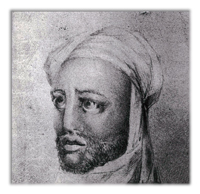
the mouth of Ahmed Bey Arabi.
Arabi was a colonel in the Egyptian
army, and the army embodied much
popular feeling, for its rank and file were
drawn from the fellaheen. And Arabi was
a man of the people: the son of a village
sheik, somewhat arrogant and boastful but simple, slow-spoken and sincere. The
army, moreover, had grievances, for the
Sultan in Constantinople still maintained
the control over it which he had insisted
upon keeping in Mohammed Ali's time.
Most of the senior officers were Turks, not
Egyptians, pay and allowances had been
drastically cut back. Arabi petitioned for
the army, but in effect his demands went
much wider. He called for an end to the
corruption of the Turkish upper class in
Egypt, and for a halt in the growing
foreign interference in the affairs of his
impoverished country.
Arabi was arrested and brought before
a Council of Ministers. But his peasant
troops burst in, toppled the Council from
their chairs, emptied inkpots over their
heads and, with guffaws of laughter, chased them out through the windows.
Political upheaval followed, and Tewfik
was compelled to accept Arabi as a
minister in a new government.
Alarm seized the creditor nations at
the prospect of revolution. The British
press - and even the Liberal, anti-imperial
Gladstone, now Prime Minister denounced
Arabi as a mutineer and a
bloodthirsty fanatic. The Europeans
utterly failed to understand that Arabi
was the national spirit of an Egypt
becoming, for the first time, articulate.
Diplomatic telegrams flew about
Europe. Britain and France drafted a
joint note affirming their support of
Tewfik; requested the Sultan to send a
force; called an international conference;
augmented their naval squadrons in
Egyptian waters. None of this had any
real effect. Savage rioting broke out in
Alexandria in the course of which European
diplomats were manhandled and a
large number of Christians killed. Arabi,
angered by the menacing foreign warships,
began to dig emplacements round
the nearby forts, and to train his guns to
seaward. On London's instructions the
British admiral called on him to stop. He
complied: but then resumed the work. On
the morning of July 11th, 1882, the British
ships opened fire.
All day the bombardment of Alexandria
continued. And on the flagship's bridge,
watching the bursting shells and flying
masonry, stood a tall mustachioed young
army subaltern on his first visit to Egypt,
Herbert Kitchener, who was to play a
dominant role in future Anglo-Egyptian
affairs. By 5 p.m. the forts were wrecked.
Inside the flaming town, infuriated
Egyptians ran wild, seeking out and
destroying anything belonging to
foreigners. British marines landed 'to
restore order.
The day's events nearly brought down
the British government. Gladstone took
refuge behind a barrage of verbiage. But
under pressure from his colleagues and
from the Opposition, he at length reluctantly
agreed that it was essential to
replace anarchy and conflict in Egypt by
peace and order: "Failing the cooperation
of Europe, this work will be undertaken
by the single power of England."
Europe - or rather France - had indeed failed to cooperate so far. France had
taken no part in the bombardment, and
for a curious reason: Bismarck, the
German Chancellor, had suddenly seen fit
to urge the French to take an active hand
in the Egyptian crisis. His meaning was
veiled: but with vivid memories of 1870,
when France had been devastatingly
crushed by the Germans, the French may
be excused for thinking that Bismarck's
purpose might be sinister - especially as a
large part of the French army was heavily
committed in Algeria and Tunisia, a
considerable distance away from the
homeland. At the critical moment the
French squadron vanished westward over
the horizon. Britain was left alone to deal
with Arabi, to keep the Canal open for her
own shipping, and to assure Egypt's
future on behalf of the creditors.
The first task was quickly discharged.
With 20,000 men, General Sir Garnet
Wolseley, the hero of imperial campaigns
in Canada and Africa, steamed into the
Canal past a gesticulating figure - de
Lesseps - standing on the quay, horrified
at the possibility that his canal might be
damaged in the hostilities. A month later
British bayonets routed Arabi's forces at
Tel-el-Kebir, and Arabi himself led the
flight of the defeated Egyptians. Britain
had wanted neither the Canal nor Egypt:
she now, ineluctably, had both.
The longer, heavier burden fell on Sir
Evelyn Baring, a member of the famous
banking family, who had served in the
Indian administration. With the modest
title of British Agent and Consul-General,
he was henceforth to govern Egypt for
nearly a quarter of a century. Patient and
adroit, Baring was to prove himself one of
the most outstanding of the British
imperial pro-consuls.
One commitment at least could be
avoided. Britain was careful not to annex
Egypt; she would, instead, administer the
country through the most suitable Egyptian
government she could find until
Egypt could stand on its own feet. Even
so, the difficulties facing Baring were
acute. He could assure his own authority
internally, for he was backed by the
power of London and by the British
occupation forces on the spot. But wherever
Egypt's international liabilities were
concerned, he had to take account of all the European creditors; in trying to steer
a course which would satisfy all, he inevitably
satisfied very few.
France, especially, had no intention of
being satisfied. She had withdrawn of her
own will: but now, jealous of Britain's
increased power in the Middle East, she
reverted to her previous role of irritant
and rival. At every turn she embarrassed
Baring by demanding to know when the
British would implement their intention
to leave Egypt.
Baring had hardly been installed when
the British in Egypt were faced by a new
threat from the south. Stretching from
Wadi Halfa towards the great lakes of
Africa, and from the Red Sea to the Sahara, lay a vast expanse of desert and
scrub threaded by the Upper Nile. Its
name, the Sudan, derived from the Arabic
word suda - black - for it was peopled by
tribes, some of Arab origin, and others,
more primitive, of black Nilotic stock.
Two major industries dominated this
huge territory: ivory and slaves. The
search for ivory caused the slaughter of
thousands of elephants each year, but far
worse were the depredations of the slave
trade. This was carried on by highly
organized raids of Arab horsemen, fanatic
Muslims, utterly ruthless, scouring the
interior on regular circuits. In the 15 years
from 1860, in only three provinces of the
Sudan, more than 400,000 people had been seized and sold, and countless
numbers more had died. Some of the
tribes were approaching extinction.
From early times Egypt had pushed
southwards beyond Wadi Halfa into the
wild cruel land of the Sudan for distances
corresponding to the ebb and flow of her
power. But Mohammed Ali had fastened
a more lasting hold on it, and his successors
had enlarged the rudimentary regime
he had established. By 1880 some 40,000
Egyptian troops were spread through
garrison-posts across the Sudan, enforcing
with their guns the rule of a Governor General
in Khartoum .
Except for a few years when English
appointees of Ismail - among them a
certain Charles Gordon - had held key
posts, Egyptian rule had been evil. Her
soldiery plundered the natives who lived
round their forts, and Egyptian officialdom
skimmed the cream off the country
as a whole. Their corruption was nourished
by the slave trade: all of them took their
cut on the traffic in human flesh as it
passed on its helpless way to the markets
of Cairo and Constantinople. Everywhere
there was poverty, oppression and a
rising tide of acute disaffection.
In 1881 an obscure man of religion,
by name Mohammed Ahmed el Sayyid
Abdullah, fired the spark
into the tinderbox of the Sudan.
From his retreat on an island in the
Upper Nile he proclaimed himself the
long-expected Mahdi - the Guided One of
the Prophet - and began a campaign of
preaching. The time had come, he urged,
to make an end of the Egyptians and
their Turkish overlords, and to return to
the purity of the true faith. The moment
was indeed ripe, for the Khedive Ismail
had been dethroned in Cairo, and in consequence
Turko-Egyptian authority in
the Sudan was weakened. The Mahdi's
fervent eloquence magnetized first the
downtrodden local population, then some
of the most warlike of the tribes.
An Egyptian force sent from Khartoum
to arrest him retired in haste. A second
was hacked to pieces. And a month before
the British bombardment of Alexandria, a larger punitive force met the same fate.
In Cairo, fear for the whole Egyptian
establishment in the Sudan was growing.
The Mahdi's swelling horde of warriors,
clad in their rough jibbahs sewn with
patches to symbolize virtuous poverty,
were getting beyond Egyptian capacity
to counter. Then, in January, 1883, came
news that the town of EI-Obeid, the
provincial capital of Kordofan, with its
well-stocked arsenal and treasury, had
fallen to the Mahdi. This success vastly
increased the numbers flocking to the
Mahdi's banner. Revolt was mushrooming into civil war.
At that very moment, Britain was
taking over in Egypt. She was preoccupied
with Egyptian problems, and she refused to extend her intervention to
the Upper Nile. "Her Majesty's Government,"
the Foreign Secretary, Earl Granville,
declared, "are in no way responsible
for operations in the Sudan." If the
Egyptian officials wished to act, that was
their affair.
That government could not swallow the
affront involved in a withdrawal. A
supreme effort must be made to suppress
the Mahdi. Accordingly, a scratch contingent
of some 15,000 men - many of
them criminals from the gaols - was
assembled and placed under Colonel
Hicks, a retired British officer from India. Hicks had no illusions about his force, but
he was determined to do his best for his
Egyptian employers. Despite doubtful
guides, he struck west from Khartoum
into the savage deserts of Kordofan. A
few weeks later the Mahdi's main army
fell upon his thirsty exhausted men. The
disaster was so complete that only 300
wounded survivors crawled away into the
tamarisk scrub. The rest, including poor
William Hicks, were dead.
The position in the Sudan was now
desperate. Baring laid the choice before
London: a British expeditionary force, or
total withdrawal. London held to its
policy: Egypt must come first, even if it
meant - as it did - installing a new
government in Cairo that would agree to
evacuate the Sudan. But how to get the
garrisons out? Made up of handfuls of
men, some were strung out along nearly
2,000 miles of the White and Blue Niles,
others were scattered deep in the interior.
The task would require a man of exceptional
calibre. At this point someone in
the War Office - it has never been clear
who - mentioned the name of Major-General
Charles George Gordon.
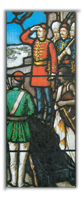
Gordon was one of the last of the fabled
Victorian eccentrics. Short, slight, sunburnt, he seemed to prance on his tiptoes
everywhere he went, boundless boyish
energy shining from his bright blue eyes.
He had fought with distinction in the
Crimea; but he was far too unorthodox
for the steady climb to the top in the
British army. Instead he had taken service
with other governments, with most of
whom he had eventually quarrelled. As a
result of his daredevil exploits on behalf
of the Manchu dynasty in the Taiping
rebellion - in which he had shown himself
a supreme leader of irregular troops he
had been universally acclaimed as
"Chinese Gordon."
Whatever spare time Gordon's worldly
battles allowed had been devoted to the
Bible, and to good works among the poor.
From his incessant readings of the former
he had evolved his own mystical, fatalistic
approach to Christianity: by his open-handed
pursuit of the latter he had sometimes
found himself on the verge of
personal bankruptcy. He was probably
the most brilliant commando officer
alive, and at the same time a man of
passionate feeling for the underdog. For
the task of organizing an abject retreat,
of unsparingly abandoning those unable
to join it, no one could possibly have been
more ill-fitted.
Gordon was no stranger to the Sudan.
He had spent nearly six whirlwind years
there, in the service of the Khedive
Ismail. He had first been Governor of the
southernmost province, Equatoria, where
he had mapped the Nile to within 60 miles
of its source, driven out the local slave
traders, built forts along the river and
forced the Egyptian garrisons into good
behaviour towards the neighbouring
tribes. It was said that he had made the
remote, dangerous region safe for a lone
traveller, even one armed only with a
walking-stick.
But Gordon's compulsive activity had
allowed him not a moment's rest, and the
terrible climate had struck at his health.
In a fit of depression he had given up,
writing to his sister that "I have a sort of
wish that I could get rid of Col. Gordon."
Within a few months he was back,
again at the plea of Ismail, this time as
Governor-General of the entire Sudan. He
refused to accept more than half of his
£6,000 salary; and as before he drove himself to the limit of his strength against
the cruelty and corruption around him.
In Khartoum his trim white-clad figure,
ceaselessly trotting to and fro, red fez
above blazing blue eyes, became for the
wretched native population the hope of a
better lot. Out on the camel-tracks
Gordon became equally familiar as he
rode from end to end of the country,
grappling with the slavers, rooting out
venal officials, appointing young Europeans,
his faithful disciples, to posts of
responsibility.
Then, once more, despondency overtook
him. He began to despair of the
conduct of his Egyptian troops, to doubt
whether slavery could ever be eradicated
in a Muslim country. Again he was
assailed by his own inadequacy: "Nothing
shocks me but myself." On Ismail's
removal he had finally resigned. The old
sleazy Egyptian regime had returned to
the Sudan. And Gordon, a bygone hero in
his late forties, was in virtual retirement
in England, on the shelf.
His appointment at the height of the
crisis created by the Mahdi was partly
due to the aura of romance that still
surrounded him. In part it was probably brought about by the more imperially minded
men in Gladstone's entourage: by
those like Lord Hartington, the Minister
of War, and General Wolseley. For while
it was under discussion, Gordon gave a
forthright interview to an influential
editor - W. T. Stead of the Pall Mall
Gazette - in which he emphasized his
belief that the Mahdist fire might sweep
the entire Muslim world unless it was
stamped out. Nevertheless, he accepted
the British government's orders, which
were to go to Khartoum, arrange the
evacuation of the Sudan, and attempt
nothing further.
Baring was strongly opposed to the
choice of Gordon, but at length to
his bitter self-reproach later he
concurred with it. The two
men had met during Gordon's
spell in the Sudan. Now, in Cairo, they
came face to face again. Their comments on
each other underlined the gulf between
them. Baring, said Gordon, "has a pretentious,
grand, patronizing way about
him." Gordon, said Baring, "was hot-headed,
impulsive, and swayed by his
emotions. He knew nothing of the springs of action which move governing bodies."
Yet Baring, having concurred, was fair
and helpful. He agreed, and obtained the
Khedive Tewfik's consent to Gordon's
request that he should re-enter Khartoum
in his former role of Governor-General
of the Sudan.
Khartoum itself had not yet been
threatened by the Mahdi's host. Communications
with Egypt were still open,
and the country round was in the hands
of loyal tribes. Gordon received a delirious
welcome in the city, and instantly set
about strengthening its morale. Chains
were struck from prisoners, bonfires made
of debt records, whips and brandingirons
from the torture-chambers piled up
and destroyed.
His energy ablaze, Gordon pelted
Baring in Cairo with up to 30 telegrams a
day, producing a spate of new ideas for
dealing with the emergency, then cancelling
them in favour of newer brainwaves.
"I have received a fresh batch of telegrams
from Gordon," Baring wearily
reported to London. "His statements and
proposals are hopelessly contradictory."
He implored Gordon to think things out
calmly, then embody his suggestions in a single message. But it was becoming clear
that the furore in Gordon's mind was
blurring the stark simplicity of his orders.
He was certain that seasoned British and
Indian troops could readily rout the
Mahdi. And he made an ominous pledge
never to leave Khartoum himself until
everyone else under his command had
had a chance to go.
Then, suddenly, the telegraph line went
dead. The tribes between Khartoum and
the Egyptian frontier at Wadi Halfa had
risen for the Mahdi. His grip was tightening.
It was no longer a question of how to
evacuate the garrison, but of how to get
Gordon himself out.
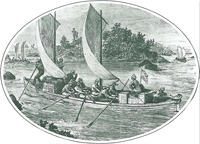
The grip was tightening, but the city
could still breathe. It had 8,000 defenders,
six months' food, and a flotilla of steamers
on the Nile. Runners could still get
through the lines. Gordon himself could
easily have slipped out to safety. And
now that the outlying garrisons were
beyond help it was his duty, in the eyes of
the British government, to do so. But
nothing was farther from Gordon's mind.
The unhappy Egyptian soldiers in Khartoum,
the bewildered population of the
city: these, in the sight of the Lord, were Gordon's personal charges. If he could not
take them with him, he would remain at
their head to the end.
Spring dragged into summer. The messages
from Khartoum dwindled. All over
England the pressure to rescue Gordon
rose to insistent levels. The Queen, as
ever, expressed the public's feelings unerringly.
"You are bound to try and save
him," she stormed at the Marquess of
Hartington, the Secretary for War, who
had been all for sending Gordon in the
first place. "You have incurred fearful
responsibility." And still the government
did nothing to mount a rescue.
In effect, all through the summer of
1884 a silent battle of wills was raging,
across the deserts andthe seas, between
two men: between Gordon in Khartoum,
with his deep conviction that to leave his
people to their fate would be "the climax
of meanness," and Gladstone in London,
with his abhorrence of subjecting the
Sudan to imperial occupation and his
belief that Gordon was trying to blackmail
him into ordering it.
Then, in late summer, Hartington
threatened to resign. This would have
doomed the government; for in his solid
phlegmatic way he reflected the image of
John Bull. Gladstone gave in. By the end
of September Wolseley was leaving Cairo
at the head of a relieving force.
In Khartoum, the situation was becoming
critical. Food was still in sufficient
supply. But some 800 of Gordon's soldiers
had been killed in a battle with the Mahdi's
men at the outskirts of the town, and the
population was losing heart. Every morning
the Governor-General trotted on his
rounds of the fortifications, encouraging,
inspecting, shoring up the shrinking
defences. Then he would climb to the
roof of his palace and spend lonely hours
with his telescope, watching the Mahdi's
horsemen manoeuvring in the nearby
desert, straining to see any sign of relief
rounding the glinting reachings of the
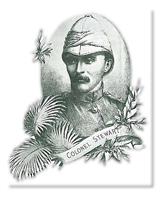
river. He decided to send one of his
steamers - the Abbas - downstream with
Colonel Stewart, his second-in-command,
in search of immediate help.
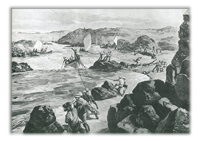
Meanwhile, Wolseley was making painfully
slow progress up the Nile. Both
Major Kitchener, sent ahead to establish
contact with Khartoum, and Gordon
himself from the beleaguered city, urged
the use of a lighter, swifter flying column. The expedition continued its steady
march. Soon the Nile began its annual
fall. The boats carrying ammunition and
supplies became more difficult to handle.
The pace slowed further.
Then daunting news reached Gordon in
the form of a letter from the Mahdi. The
Abbas had been captured. Stewart and
most of the boat's complement had been
put to death. And all the information she
was carrying about the increasing plight
of Khartoum had fallen into enemy hands.
"Now," the Mahdi concluded menacingly,
"we understand everything." He demanded
that Gordon capitulate voluntarily:
a forced surrender would not be
accepted. And he moved his armies forward
to ring the city.
As the year's end approached with
still no sign of Wolseley, Khartoum's
food gave out. Every
animal down to the rats had
been eaten. Corpses were lying
in the streets. In the solitude of the palace,
Gordon was pouring his passion into his
journal - a strange compound of cynicism,
high faith and growing despair, scribbled
over waste paper and old telegraph forms
- that remains among the most poignant
of English records. "I have given 6,000
lbs of biscuit out to the poor. I expect half
will be stolen.... The shells fall about 200
yards short of the Palace. One hears the
soft sighing coming nearer and nearer till
they strike... About forty females congregated
under my window, yelling for
food.... I have given the whole garrison
an extra month's pay - I will not .. hesitate
to give them £100,000 if I think it will
keep the town.... I am worn to a shadow
with the food question. Five men deserted
today."
With his hair turned snow-white, he
held on. One evening, with the bullets
spattering against the walls, he sent for a
leading merchant of the city and insisted
on sitting with him in a window lit up by
the largest lantern available. "When God
was portioning out fear," he said to his
companion, "at last it came to my turn,
and there was no fear left to give me. Go,
tell the people of Khartoum that Gordon
fears nothing."
At Metemma, 100 miles north of the
city, Wolseley's advance guard met four
of Gordon's steamers, sent down to provide
speedy transport for the first relieving troops. They delivered Gordon's
journal, which he had handed over sewn
up in a cloth before the ships left, with its
urgent final plea: "NOW MARK THIS,
if the Expeditionary Force does not come
in ten days the town may fall. I have done
my best for the honour of our country.
Good bye." But almost simultaneously a
runner brought in another message :
"Khartoum is alright. Could hold out for
years." It had probably been sent to
deceive the Mahdi's scouts. But the
British commander on the spot acted on
it. Three more days were lost in overhauling
the river craft and reconnoitring
the country ahead. They waited too
long.
Already, on January 25, 1885, the
Mahdi, alarmed by Wolseley's approach,
had ordered the attack. The Egyptian defenders,
weakened beyond further resistance
by fear and hunger, had collapsed.
Six terrible hours of massacre, rape and
loot had followed as the shrieking hordes
burst through the streets. Gordon, spruce
and coal in his dress uniform, had met the
invaders on the staircase of the palace.
Against the Mahdi's orders he had instantly
been speared to death. His head
had been cut off, his body had been flung
into a well.
Two days later the steamers, crowded
with troops, arrived within sight of
Khartoum. They could see no flag flying
from the Governor's palace, and as they
neared the town they ran into a tempest
of fire. Wolseley, seeking reinforcements
for a further campaign against the Mahdi,
was curtly told to return; and his expedition
retired in some disorder down the
Nile. In England, a wave of hysterical
anger swept the country. Crowds gathered
in Downing Street to hoot and hiss at
Gladstone. He was saved by Russia: for
the Russians, choosing the moment of
British distraction, made a lunge towards
the Oxus and India. Gladstone loosed the
full fury of his oratory upon them, and
succeeded in diverting public wrath from
himself to the Tsar.
But beneath the surface, profound
national feeling had been lastingly roused.
De Lesseps, Arabi, the Mahdi: by these
men imperial Britain had been dragged in
remorseless succession into the Canal,
Egypt, the Sudan. But nearly everyone
knew that the deepening involvement
could not be allowed to end in ignominy.
|
| The re-conquest of the Sudan
began in 1896. It was probably
inevitable from the moment of
Gordon's death: but in the intervening
years reasons beside that
of wounded pride accumulated.
The Mahdi died shortly after his famous
victim, and his place was taken by his
principal aide, the Khalifa Abdullah.
Every report percolating from the Sudan
confirmed that Abdullah's rule was
vicious, that the slave trade was more
active than ever. The influential philanthropic
societies in Britain exerted constant
pressure for the eradication of the
regime that was fostering slavery.
Then, in 1892, Baring became Lord
Cromer. It was clear that his labours in
Egypt were proving a phenomenal success:
the Egyptian budget was already in
surplus, and the revenues were being
prudently invested where they could remultiply
their yield. The country was
solvent, merchants were prosperous. As
for the fellaheen, after so many centuries
of misery, at least forced labour and the
kurbash had gone, and living was a little
more secure. Such civilizing progress, it
was urged, should not be confined to
Egypt; the Sudan deserved attention.
Two years later Gladstone finally
retired from politics; and the Tories who
replaced him in 1895 had none of the
Grand Old Man's aversion to imperial
enterprise. The scramble of Europe for
colonies in Africa was gathering momentum,
and the Tories were quick to point
to the danger of leaving a power vacuum
on the Upper Nile. And from that scramble
came the clinching event that was to set
the wheels in motion. On March 1st 1896,
the Italian army, in its attempt to occupy
Abyssinia, was crushingly defeated at
Adowa; and stories circulated of the mass
castration of the prisoners. European
prestige was at stake. Moreover, there
was an Italian outpost at Kassala, just
within the eastern Sudan, and the
Khalifa's warriors were threatening it.
Italy, with German support, appealed
for diversionary help. Twelve days later
the British decided to invade the Sudan.
The Sudan expedition of 1896-98
stirred public pride and patriotism as few
previous imperial campaigns had done. It
coincided with Victoria's Diamond Jubilee:
sentiment for the British Empire was at its zenith, and the symbols of its
splendour were visible on every hand.
The triumphant advance up the Nile
would be the crowning achievement: it
would avenge the heroic dead, replace a
cruel despotism by benevolent rule, add
still another red patch to the map. And
Kitchener, the stem silent man of action,
whose grim moustaches projected the inflexible
purpose of Britain, would be in
command. Victory was sure - and, comfortingly,
at minimum expense; for
Kitchener was highly cost-conscious.
That stiff, forbidding figure, now Sirdar,
or Commander-in-Chief, of the British trained
Egyptian army, had no intention
of disappointing expectation. Surly, frugal,
exacting, disliked by his officers for
his inordinate ambition, aloof from his
men yet revered by them for his unbending
will, he was not the man to tarnish
his own image by any hint of failure.
There would be 10,000 Egyptians under
British officers, and about the same
number of crack British troops. They
would be equipped with every modern
form of weaponry and supply. Overwhelming
batteries of artillery would be
brought to bear, using the new high
explosive, lyddite. The firepower of the
rifle brigades would be formidably augmented
by the new Maxim machine-guns.
Powerful gunboats of novel design would
be launched on the Nile; and a special
railway, built across the Nubian desert,
would cut out the long march round the
great bend of the river above Wadi Halfa.
The objective would be Omdurman,
the squalid town across the Nile from
Khartoum that was the Khalifa's capital
and the Mahdi's burial-place. There
would, however, be no undue haste to
reach it, for now there was no one awaiting
relief. And at every measured step,
rigid economy was to be observed.
So Kitchener's juggernaut, efficient
and relentless as its master, rolled up the
Nile; and in London frock-coated peers
and silk-hatted bankers, clerks and
cabbies, bootblacks and barmaids devoured
the special editions with their
telegraphed reports. They read of the only
important action fought on the way: of
the storming of the Emir Mahmud's barricades
at the Battle of the Atbara, pipes
skirling, fifes shrilling, drums beating; of
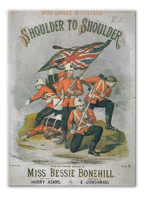
Kitchener cheered to the echo by men hoisting their helmets on bloody bayonets
as he rode along the lines. They read of
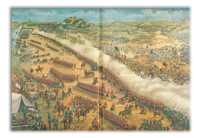
the climax within sight of the dome of the
Mahdi's tomb at Omdurman: of the
Khalifa and his generals hurling their
50,000 gleaming spearpoints at the British
guns; of the Egyptian brigades wheeling
steadily to concentrate their deadly fire;
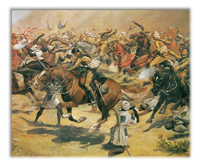
of the 21st Lancers charging, young
Winston Churchill with them; of the
heaps of half-naked dead piling up before
the sputtering Maxims; of the gunboats
thundering from the river, Lieutenant
David Beatty, a future First Sea Lord, in
command of one of them; of the dark
hordes fleeing vanquished into the desert;
of the memorial service to Gordon, with
the massed voices of the soldiers singing
his favourite hymn "Abide with Me" and
the British and Egyptian flags slowly
rising into the azure sky; of the Sirdar
who detested all emotion, unable to
control his shaking shoulders.
From start to finish it had been a set-piece
with a foregone denouement.
But in the quieter, more
rational months that followed, the
hoisting of the two flags side by side
took on a lasting significance. For Cromer,
artist in "the springs which move governing
bodies," devised a novel formula for
the future governance of the Sudan: a
formula that would at once mitigate the
burden to Britain of annexation, keep
Europe at arm's length, and acknowledge
the cooperation which had routed the
Khalifa. The conquered land would henceforth
be ruled, and its initial development
financed, by Britain and Egypt as
partners. It would be a Condominium:
the Anglo-Egyptian Sudan.
For Kitchener, however, Omdurman
was not the end of the campaign. Just
before the battle he received secret orders
from London which were not to be
opened until Khartoum had been retaken.
When the city was his, he broke
the seals and read the contents. They informed
him that a French party under a
Captain Jean-Baptiste Marchand was
believed to have crossed Africa from the
west coast and to have reached the Nile
farther upriver. He was to proceed upstream
at once and dislodge any French
force he found.
The exclusion of France from the affairs of British Egypt - though brought about
by her own choice - had all along rankled
the French government. Andwhen Britain
had begun the re-conquest of the Sudan,
French official anger had boiled over.
Her rival's occupation, Paris had decided,
must be forestalled. A token French
presence should arrive on the Upper Nile
before the Anglo-Egyptian army; and,
joining hands with the Emperor of
Abyssinia, it should formally take possession
of the country round. Control of
the headwaters of the Nile would be a
powerful bargaining-point where Egypt
was concerned.
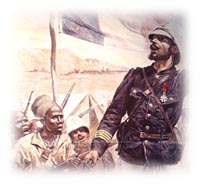
Accordingly, while Kitchener was
working his way up the Nile, Marchand
was pushing across Africa from Brazzaville
with seven other officers and 120
Senegalese troops. His feat was a tour de
force calling for the highest courage and
endurance, for he marched through 3,000
miles of unmapped equatorial forest and
swamp. Six weeks before the Battle of
Omdurman he emerged on to the Nile
near a group of mud huts called Fashoda.
Fashoda was a hell-hole: malarial, and
appallingly hot. Under the Egyptian
regime there had been a prison in the
locality for hardened criminals with life
sentences. But before he left Khartoum,
Kitchener got definite word from a native
source that tents had been erected there,
and that the tricolour was flying over
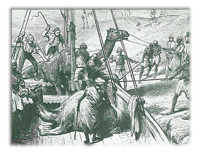
them. He took with him five steamers,
two battalions of Sudanese, a company of
Cameron Highlanders, a battery of guns
and four Maxims. And at Fashoda he
duly found Marchand.
On occasion Kitchener could be a
rough, harsh bully. And his strength on
the immediate ground was overwhelming.
But he was aware that the French government
was prepared to back Marchand to
the hilt, and that peace or a major
European war might be in the balance.
And by some quirk of fate the two men
took an instant liking to each other. They
dined together - Kitchener spoke fluent French - and afterwards, over coffee and
liqueurs, got down to business.
Both showed courtesy, restraint,
finesse. Kitchener pointed out that his
instructions were to take possession of the
Upper Nile. Marchand admitted that he
could not prevent him from doing so.
But, he went on, he was unable to withdraw without orders from Paris. And if
Kitchener used force, he and his men
would die at their posts. His host was
aware what that would mean. Kitchener
placed his communications at Marchand's
disposal; the offer was accepted.
When the encounter at
Fashoda became known, a
convulsion of fury seized
Britain and France. The press
of both countries attacked
each other with unprecedented virulence.
The British papers accused Paris of trying
to rob their country of a hard-earned
victory by a facile trick. The French
insisted that Britain had abandoned the
Sudan after Gordon's death; that Marchand's
prior presence now made the territory theirs; that they would not be
bluffed out of their rights by yet another
instance of Albion's perfidy. The situation
built up into a crisis of the utmost gravity:
war seemed a possibility.
At this point Kitchener, having handed
over to his second-in-command at
Fashoda, returned to England. The hero's
welcome that greeted him became a
frenzied anti-French demonstration.
Then the Prime Minister, Lord Salisbury,
rising to speak at a state banquet in his
honour, announced that France had
decided to withdraw; and the storm
abated as quickly as it had blown up.
There were several reasons behind the
decision. The French government had
realized that no real help was to be
expected from Abyssinia, and that their
lone position on the Upper Nile was untenable.
Moreover, while Britain was
wholly united on the issue, opinion in
France - and especially in the French
army - had suddenly been torn apart by
the case of Captain Dreyfus: that unjust
conviction of an officer accused of spying
provided a passionate rallying-point for
left-wingers in a long, bitter and ultimately
successful struggle against reactionaries
in the army and Church.
The good sense shown by the men on
the spot at Fashoda made possible a graceful
French departure. And that in turn
had profound consequences. A few months
later the two governments signed an
agreement defining their spheres of influence
in equatorial Africa; this agreement
was one of the factors that paved
the way for the Entente Cordiale, the
"friendly understanding" that set Anglo-French
relations on such a smooth course
in the first decade of the 20th Century. In
effect, the fiery moment at Fashoda not
only ended two centuries of bitter imperial
rivalry, but contributed to the
tremendous shift in the balance of Europe
that finally answered the appearance of
the German Empire in 1871.
But from the day of Arabi's downfall
at Wolseley's hands, France had been
asking that pertinent if awkward question:
when would Britain leave Egypt?
Palmerston had defined his attitude to
Egypt by an analogy: "When I travel
from London to York, I like to find a comfortable
inn on the road. But I do not
want to own the house." Having willy
nilly become the owner, Britain did much
to set the house in order. The structure
itself had been partly modernized before
she came - by Mohammed Ali, Said and
Ismail. But their supervision had been
chaotic, and their financing disastrous.
Cromer changed all that. To a country
by nature hard-working but distorted by
centuries of unscrupulous government, he
gave a long cool sight of the virtues of
"sea-green incorruptibility." For a nation
pinioned by foreign creditors taking
shameful advantage of its inexperience, he negotiated a large measure of relief.
And for a people critically dependent on
water for their prosperity, he set new
sights of productivity.
Cromer's irrigation engineers made possible
the doubling of the sugar crop of
upper Egypt, and the trebling of the
cotton crop. The giant High Dam at
Aswan, completed in 1968, is only an
extension of the great system of water storage
and control of which Cromer's
men laid the foundations.
The Anglo-Egyptian Sudan, ravaged
by the slave trade and by Mahdist rule,
was set upon a similar road. Its first
Governor-General was Lord Kitchener
of Khartoum; and Cromer, in one of his
more masterly understatements, said that
his methods were "perhaps a little more
peremptory than is usual in civil affairs."
But Kitchener assembled a hand-picked
group of young men from British uniuniversities,
and so formed the nucleus of the
Sudan Civil Service that came to rival its
Indian twin in ability and devotion.
Honest, capable government; solvency; progress in physical development:
great gifts, of permanent value - especially
in the foetid Turko-Egyptian context of
the time. But the receiver-in-bankruptcy
having become the good steward, Britain
could not bring herself to relax her grip:
partly because the Canal she had sought
to stop had become vital to her; but
partly also for fear of seeIng her wider
work undone. And her work in Egypt
inevitably came to reflect the personal
beliefs and prejudices of the pro-consul
who presided over it for so long.
In economic affairs, Cromer's outlook
was laissez-faire. He encouraged foreign
investment, but left it to seek profits
where it could without reference to the
overall benefit of Egypt. As a result, few
new industries appeared to offset the
country's unbalanced dependence on cotton
and sugar; and in any case Europe
wanted primary materials rather than
industrial competition. In social matters,
Cromer believed fervently in self-help:
under him poverty was largely left to
charity, health - except for quarantine
enforcement - to private initiative, and
education to the recruiting requirements
of the government service.
But Egypt's deeper discontent with
Cromer's rule stemmed from his perpetuation
of Britain's original political misjudgments.
Twice, in the early days of
her intervention, she failed to perceive
the genuine nature of national feeling
astir from below, from end to end of the
Nile. Twice she mistook national movements
- of reform in the case of Arabi,
of protest in that of the Mahdi - for mere
outbreaks of anarchy and fanaticism.
Cromer then underlined Britain's lack of
feeling for the Egyptians by placing
beside each Egyptian minister a British
"Adviser" whose powers were far greater
than their title suggested.
Since she never came to terms with
national aspirations, Britain could never
answer the question of when she would
leave. The question of her departure was
finally answered for her by Nasser in 1956.
Her presence had at last come to be seen
as different only in degree, not in kind,
from that of the long chain of foreign
conquerors that had preceded her. |