|
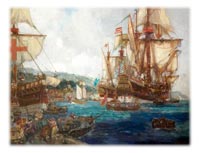
Asia was the very first target of imperial and commercial activities for the English. The Silk Route had long brought back goods that were desirable by the wealthy and well connected in Europe. The English, amongst other nations, watched with envy as Portuguese fortunes were made through their Oriental maritime trading from the end of the 15th Century onwards. Portuguese caravels returned with spices, silks and other exotic goods that sold at impressive prices back in Europe. The Portuguese jealously guarded these trade routes to maintain their privileged position around the Cape of Good Hope and into the Indian Ocean. It did not help when the Spanish seemed to find their own wealth creating opportunities with the discovery of the 'New World'. Eventually, even Spanish would later discover a less easy route to the Orient through the Magellan Straits or around Cape Horn. A land route across the narrow isthmus of Panama would prove an easier route and would later link Spanish trade routes with the Philippines. England was forced to watch from the sidelines as Iberia turned itself into an economic powerhouse off the back of their maritime endeavours.
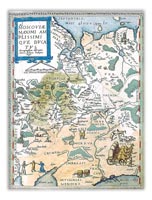
The English were relative late-comers to the commercial opportunities presented by maritime trade on an oceanic scale but that did not prevent them from trying to discover their own routes to the Orient. The first English attempts were to try to discover a North-West passage linking Europe to Asia. John Cabot in the service of Henry VII and his son Sebastian Cabot in the service of Henry VIII probably represent England's first serious attempts at maritime exploration on an inter-continental scale. The hoped for route appeared elusive in the wastes of North America and the Arctic Sea. With disappointing results, Henry VIII turned his attention back to European dynastic politics for most of his reign. However, towards the end of his reign he did allow the formation of a company which had a novel plan for discovering a North East Passage to the Orient. The Muscovy Company was given permission to find navigable rivers to penetrate Russia with a view to getting to China and the Spice Islands. Attempts to find this new passage were continued into the reign of Edward VI under explorers like Sir Hugh Willoughby and Sir Richard Chancellor. Again weather and the icy conditions of the Arctic defeated the grand aims of the enterprise but Chancellor was at least able to establish trading relations with the rising power of the Russians. Although the Hanseatic League, Poland and Lithuania lobbied hard to reduce the amount of trade with what they regarded as a hostile and barbarian rival. There were still more attempts to discover trading routes along the rivers of Central Russia but these invariably foundered once reaching the Muslim khanates of Central Asia which already had their own established trading partners and did not wish to disrupt existing trading patterns. The Muscovy Company would ultimately eke out an existence as a whaling and fur company but would never gain access to the trade routes that were so craved by their investors back in England.
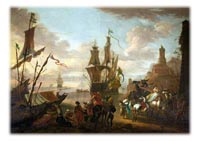
A third alternative for connecting to the trade of Asia was through the Mediterranean Sea and to trade from the ports of the Near East. The Levant Company was set up in 1580 and set up a base of operations in Aleppo. This was only ever a trading concession and had to purchase goods which had passed through many hands before reaching the Ottoman ports of the Eastern Mediterranean. It had to pay for the rights to trade in the Ottoman Empire and also had to deal with pirates lining North Africa ready to descend on merchant vessels taking the last leg home with their exotic goods. These routes provided the company with a steady but not spectacular income stream as the various middlemen and tax collectors all took their cut. There were also plenty of other European rival trading companies who would bid for the goods at the Ottoman ports and so pushed prices yet higher. Additionally, there were frequent interruptions in the flow of goods when wars broke out in the interior of Central Asia or if relations with the Ottomans were threatened. There were still traders who dreamed of loading up their ships with goods at rock bottom prices in Asia and shipping them directly back to the lucrative markets of Europe.
There were yet more attempts to discover a North West passage by Humphrey Gilbert and Walter Raleigh amongst others but the geography and weather still defeated them. It became increasingly clear that in order to try and find a direct maritime route to Asia, England would have to try and muscle in on the established Spanish and/or Portuguese trading routes. The first Englishman to make attempt this was Sir Francis Drake. Drake was the first Englishman to successfully enter the Pacific Ocean via the Magellan Straits. His main target was the Spanish gold and silver from South America but it was his route back to Europe via the Philippines and Asia that caught the imagination of other English sea farers who hoped to replicate his endeavour and travel to the Spice Islands for themselves. Initial plans were deferred until after the threat of the Spanish Armada had been dealt with but in 1590s a series of expeditions ventured directly to Asia via the Cape Horn and via the Cape of Good Hope. They were challenging the established routes of Spain and Portugal only to find that their fellow religionists, the Dutch, had already gained a march on them and were busily challenging and increasingly supplanting the Portuguese. Nevertheless in 1600 an English East India Company was formed to try and make its own contracts and trading deals in Asia.
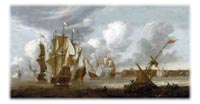
The English opened up trading factories in Bantam, Banda,Surat in India and even in Hirado in Japan. But time and again the English East India Company found that a combination of the established Portuguese or the ambitious Dutch conspired to shut them out of the most lucrative trading destinations. The English would fight continuously with the Dutch throughout the Seventeenth Century and generally came off second best. The Dutch concentrated their efforts and military skill on defending the most lucrative markets of the Spice Islands (modern day Indonesia) whereas the East India Company was left with small toeholds on the periphery of India.
The factories continued to trade but without the colossal returns that the Dutch were making on their investments. There were also many setbacks to the English factories as local politics, piracy and disease ravaged the company's outposts. Over time, the English concentrated their efforts on three key factories in the Indian sub-continent; Calcutta in the East, Bombay in the West and Madras in the South. It was not until the Seven Years War that the East India Company would become the most powerful of the European powers in India and that this would slowly allow Britain to become the most powerful of the European powers in Asia. During the Seven Years War, France and its own French India Company were comprehensively defeated and displaced by the English East Company with help from the Royal Navy. As a reward for its victory, the East India Company was given the rights of gathering its own taxes in Bengal. This started the process whereby the company became a government in its own right. With a guaranteed income, it no longer needed to rely solely on trade and so could afford to expand militarily in order to expand its tax base. Over the next century it would grow and expand its reach throughout the Indian sub-continent.
The pre-eminent position of the Dutch in Asian trade was severely reduced during the Napoleonic Wars. Once the Netherlands had been conquered by Napoleon, her colonies, shipping and assets became fair game for the British. This was especially the case after Nelson's victory at the Battle of Trafalgar. Dutch colonies were hoovered up and the most lucrative or best strategically placed were kept at the end of hostilities. The Dutch would never again challenge the power of Britain and the East India Company reaped the benefits of this privileged position.
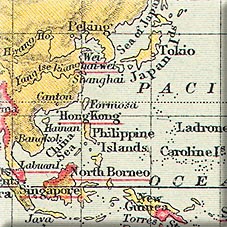
As the East India Company became wealthier, it could look to other trading opportunities and sought to expand and encourage trade with China, establishing a base in Singapore to help coordinate this trade. The East India Company was interested in the tea and silk from China but the Chinese were only interested in receiving payments in silver from the British. The East India Company produced no products of interest to the Chinese authorities. However, there was one product that was of interest to some in Chinese society; Opium. The English East India Company preferred to sell this addictive drug rather than using its cash resources for trading with China. This would eventually put Britain on a collision course with Chinese officialdom which resulted in the Opium Wars of the 1840s and late 1850s. By this time, the industrial power of Britain with its cutting edge military technology meant that it held a decisive advantage over China. The resulting wars were fought ostensibly for 'Free Trade' principles but in reality were to allow Britain to continue its exploitative trading relationship over the Chinese. Britain was to receive Hong Kong as a base to ensure that it had access to Chinese trade and ports. This port would grow to become an important trading entrepot connecting the British Empire to the resources of China.
With its dominant positions in India and China, Britain would spend much of the rest of the 19th Century extending its economic and political powers to defend these interests, trade routes or fill the spaces in between. Therefore, much of the Middle East was taken to safeguard routes to India. Burma, the Malay States, Borneo were trading destinations frequented by ships going to and from India and China or harboured pirates who could disrupt that trade and so came within the purview of the British. Even the traumatic disruptions of the Indian Mutiny would just see the commercial East India Company replaced by the even greater resources of Her Majesty's Government with the formation of the Raj. Central Asia became a battleground for influence as Britain tried to prevent the spreading power of Tsarist Russia from impinging on its Jewel in the Crown of India. There became a logic of expansion in order to safeguard the most valuable parts of Britain's Asian Empire; India and China. The latter may not have been painted red like the former, but Britain had all the benefits of access to the markets of China without the responsibilities of running it or providing it with an administration or an infrastructure. These two giants lay at the centre of British interests and concerns until the middle of the Twentieth Century.
Britain's pre-eminence in Asia was challenged in the Twentieth Century by the rise of Japan and its desire to have a 'seat at the table' of European Imperialism and the increasing interest and involvement of the United States as ideas of 'Manifest Destiny' spilled over into the Pacific Ocean. Japan was initially an important ally of the British who felt that they had found a nation with similar aspirations to their own being an island nation off the coast of a powerful continent. Japan aided Britain and the Allies in World War One which allowed both Britain and Japan to add further German colonies to their own accounts. In fact, Britain's insistence at honouring Japanese claims on ex-German colonies North of the Equator caused ructions with the colony of Australia which was perturbed to see non-European expansion in her hemisphere. In the 1920s, Britain was encouraged by the United States to terminate its alliance with Japan during the Washington naval conferences. Japan duly set about expanding its own empire with an increasingly introspective nationalist regime. It had already taken Korea after war with Russia but now it expanded into China and then felt that it spotted an opportunity in 1941 when it saw the British and Dutch embroiled in war back in Europe. It seemed an ideal time to pounce on the busy imperial powers. However, the American colony in the Philippines lay astride of their target of the oil rich Dutch East Indies. The Japanese therefore decided to attack the American fleet in Pearl Harbour in order to give its Imperial Navy a free hand in South East Asia. The British suffered a catastrophic defeat in Malaya and especially in Singapore which revealed Britain's relative lack of military power in the region for all to see. The Australians turned to the Americans to help secure the defence of their mainland as the British had to prioritise its resources to Europe and North Africa. India continued to play a vital role, but promises of self-government had to be given in order to ensure cooperation and loyalty from rising nationalist and independence movements there. A change of government to Labour in 1945 gave India its opportunity to become independent from Britain and started the dominoes falling throughout the region.
The rise of Communism in several colonies allowed Britain the excuse of maintaining links and military involvement in places like Malaya and Borneo longer than had been anticipated, but even there, independence was the ultimate carrot to help end Communist insurgencies. The loss of control of the Suez Canal in 1956 and the embarrassing nature of the episode further eroded British power and prestige in Asia. Military commitments were slowly run down until in 1968, the British declared that they would be withdrawing all significant military commitment from East of the Suez, basically from Aden to Singapore to Hong Kong, by 1971. Britain was no longer a major player and only held onto Hong Kong until 1997 when part of its lease was due to return to Chinese control. This handover marked the end of Empire in Asia. It had always been Britain's most economically active region but the end of Empire did not see the end of Britain's economic and cultural ties to the region. British concepts of free trade, legal systems and the English language, amongst other aspects, still play a fundamentally important role in many of the countries of this region down to the present day. The Empire may be gone in Asia but aspects of its legacy continue on.
|