|
Discovery
|
|
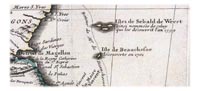
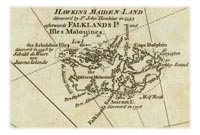
The initial claims to discovery of the Falkland Islands are many and varied. Who really discovered them is open to debate. Claims to sighting the islands have been credited to Amerigo Vespucci in 1502, Esteban Gomez from the Magellan Expedition in 1520, and to the Camargo expedition of 1540 to name but a few. None of these can be verified but the islands certainly started appearing on early Spanish maps of South America in the Sixteenth Century. The first English person to have sighted the islands is claimed to be John Davies on the Desire in 1592. Davies and his ship had been driven by storms towards "certain Isles never before discovered by any knowen relation." This visit was said to have been followed up by his contemporary Sir Richard Hawkins in 1594, although there is scant evidence for this visit. Despite this fact, it was said that Richard Hawkins named the islands 'Maidenland' in honour of Queen Elizabeth, this name started to be used on early English maps of the South Atlantic. Another name that it acquired in the Seventeenth Century was the Sebaldes after the Dutch sailor Sebald van de Weert who came across them after emerging from the Straits of Magellan in 1600. What must be pointed out is that any sightings were reported in order to forewarn and prepare sailors in a treacherous part of the world's oceans and not for any claim of ownership or responsibility for them. Turbulent seas and rocky coasts do not bode well for seamen ignorant of the waters and landmasses. Mapmakers back in Europe were eager to draw accurate charts for their clients and they hungrily devoured information from returning seafarers in their strive for precision. They particularly valued corroborating evidence and it seemed clear by the Seventeenth Century that an archipelago lay off the coast of South America.
What is clearly established is that the first recorded landing on the islands was by Captain John Strong Commander of the Welfare on January 29th 1690 . Strong was actually on his way to try and locate the wreck of a Spanish treasure ship off the coast of South America, a mission that ultimately failed. Captain Strong had been in need of fresh supplies and water; "..this morning we weighed and stood unto an harbour on ye west side and there came to ane anchor and sent our boat on shoar for fresh water and did kill abundance of geese and ducks but as far as wood there is none." He named the sound between to the two main islands, Fawklands Channel after the sponsor of the journey and its hunt for treasure, Anthony Cary, 5th Viscount Falkland. Over time, the name Falklands would come to refer to more and more of the archipelago until eventually it became synonymous with the whole chain of islands.
During the 16th and 17th Centuries, the Spanish had been steadily increasing their power and influence throughout Central and Southern America. She was more interested in the gold and silver of the mainland rather than any barren, windswept collection of islands. The Spanish did, however, claim hegemony over the entire continent thanks to the 1494 Treaty of Tordesillas. This divided Spanish and Portuguese empires along a meridian 370 leagues west of the Cape Verde islands. This agreement was at the insistence of the Pope to ensure that two of his most dependable Catholic nations did not fall out over colonial expansion in the New World and in the Indies. The Falkland Islands came firmly within the Spanish orbit by this definition. It should be said that no other powers in Europe recognised this agreement as it was regarded as a corrupt decision by the dissolute and corrupt Spanish-born Borgia Pope. England was still a staunchly Catholic nation at this time and found itself in the unusual position of agreeing with the French and all other maritime nations of Europe in stating that the Pope had no such right to make this secular and political decision. It was therefore consistently ignored by all powers except for Spain and Portugal who themselves abandoned the agreement in 1750.
Various ships from France started exploring and mapping the area at the end of the Sixteenth and early Seventeenth Centuries. The French were trying to find lands suitable for French colonies as they sought to muscle in on the trading successes of Spain and Portugal. Captain Jacques Gouin de Beauchene set sail for the Southern Seas in 1698 and explored the Straits of Magellan for seven months. He entered the Pacific but found little of value that had not already been claimed by the Spanish. He returned to the Atlantic via the Cape Horn but as he was sailing homewards he stumbled upon the most remote island in the Falklands archipelago, which is still called Beauchene in his honour to this day. His journey sparked further exploration from other French ships. Most of these voyages started from St. Malo in Northern France. They seem to have come across the rest of the archipelago and its name started to appear on French maps as the St Malouines in recognition of their endeavours. These voyages are marked on a 1747 Map of South Atlantic.
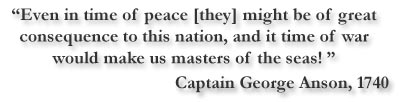
The British were first alerted to the strategic opportunities of possessing the islands thanks to George Anson in 1740. He understood the vital strategic role of the Cape Horn and Magellan Straits for linking East to West. The long sought North-West Passage had failed to materialise and it was becoming increasingly clear that this was the only maritime connection point between the Atlantic and Pacific Oceans. Anson wondered if the Falkland Islands might not make for an excellently placed anchorage from which to prepare for the hazardous journey around the Horn or to recover from one. Anson tried to sell the idea of a settlement to his Government which was duly deliberated upon.
|
|
Competing Colonies
|
| Whilst the British were prevaricating about committing to a settlement, the French embarked on building one on the islands in 1764. France had recently been defeated in the Seven Years War and was looking for new opportunities in the light of being expelled from Canada and other bases around the world. France felt that challenging the waning power of Spain might make for an achievable goal. They wanted a base to challenge Spanish hegemony in South America and felt that these islands might make a useful starting point.
Louis-Antoine de Bougainville organized a settlement in 1764 with the permission of his king. Bougainville landed in February 1764, reaffirming the French name for the islands as 'Les Iles Malouines' and the port on the eastern island as 'St. Louis' after the French king. 29 settlers were initially left by the Bougainville but the small settlement grew to a 135 at its peak. These settlers were in the main from Arcadia (French Canada). Bougainville himself had played an important part in the unsuccessful campaigns of the Seven Years War in Canada. They were effectively homeless and wished to escape from the clutches of the newly expanded British Empire in North America. These islands seemed to provide a new and patriotic place to start their lives all over again. However, the settlement came to the attention of the Spanish Court who were jealous of any encroachments into its sphere of influence. Back in Europe, the Spanish lobbied furiously against the settlement in the French court.
Meanwhile the British had not forgotten Anson's suggestions, who had become a key player within the Admiralty before his death in 1762. It was thanks to his tireless lobbying that Britain finally sent its own expedition to the islands in 1765. They landed on the western island and were ignorant of the fact that the French had arrived and had their own base on the far side of the eastern island. Commodore John Byron on the Dolphin was sent to reconnoitre the islands and assess their suitability as an anchorage. He reported that 'the whole navy of England might ride here in perfect security from all winds.' The Admiralty were impressed enough by his reports to send a second expedition with a view to establishing a permanently manned base and port. Captain John McBride on the Jason arrived with a garrison, cattle, sheep and pigs enough to support a settlement of about 100 strong. The port was called 'Port Egmont' in honour of Lord Egmont the first lord of the Admiralty who had sponsored the mission. When the Jason did a complete survey of the island, they were surprised to come across the French at St. Louis. They requested that the French leave the islands as the British claimed sovereignty over them, but this request was ignored by the nascent French settlement who may have been aware of negotiations between the Spanish and their own government over the future of the French settlement anyway.
Spain was now aware of the two competing settlements on an archipelago that it considered fell within its sphere of control as clarified by Article 8 of the Treaty of Utrecht in 1713. However, the Spanish were not entirely clear where Port Egmont was to be found. Spain was unhappy but recognized that the French were the easiest to deal with as the two Courts were related, and after a little persuasion Bougainville signed over his settlement to the Spanish in return for financial compensation equivalent to 25,000 pounds. Complaints to the Court of St. James in London were less effective, but there was little the Spanish could do without knowing where exactly the British settlement was located.
|
|
The Spanish Assert their Claim
|
|
Bougainville formally handed over to the Spanish in a simple ceremony as Port Louis in April 1767. The Islands were renamed by the Spanish as the Islas Maluinas, and Port Louis became Puerto Soledad. During 1768, Spain issued orders for its colony in Buenos Aires to seek out the British and expel them.
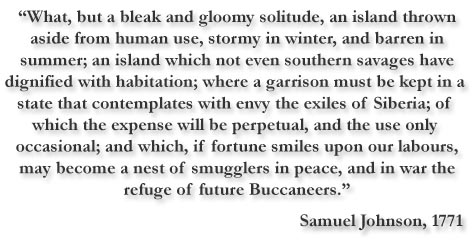
In November 1769, the British commander at Port Egmont, Captain Hunt, observed a Spanish schooner and required it to leave the Islands but within two days a message arrived from Puerto Soledad demanding that Hunt be the one to go. Hunt refused. Shortly afterwards, in June of 1770, a Spanish fleet of 5 fighting ships turned up at Egmont carrying 1,400 soldiers. The British population of Port Egmont only numbered 100 at this time. After a brief exchange of fire they expelled the tiny British garrison out from its settlement and into the interior of the island. There was now a real risk of conflict. Hawks and doves on both sides clamoured for or against war. It was at this time that Samuel Johnson added his famous comments to the worthiness of fighting a war over the Falkland Islands. The British prepared a battle fleet of their own of 26 warships lying off Spithead ready to attack Spain when the order was given. It was a very real threat and one that France and Spain did not wish to test at this time. The French King was particularly unwilling to involve his country in yet another ruinous and expensive conflagration so soon after the setbacks of the Seven Years War. The result was an 'accommodation', whereby everything returned to the position that it had been in 1769. The British garrison was allowed to return to Port Egmont on the Western side of the Falklands and have their goods and accommodation returned and repaired. The Spanish returned to their base at Puerto Soledad and the soldiers and fleet returned to South America. The issue of sovereignty was avoided. Spain still claimed the islands, as did the British.
Unfortunately for the British, events elsewhere in the Americas would lead to Port Egmont having to be abandoned. The seeds of revolution were taking root in the 13 colonies and manpower and maritime assets were vital concerns to the British. The strategic situation in North America required changes to British military dispositions and priorities resulting in the withdrawal of the garrison in 1774. They left behind them a flag and a plaque proclaiming British sovereignty over the islands and stating their intention to return.
The Spanish remained on East Falkland, venturing across to the western isle to retrieve and remove the plaque in 1775. In 1780 they came across once more to destroy the last vestiges of the abandoned settlement. By this time, they were openly supporting the American Revolutionaries against the British and so this action could be used as evidence of Spanish support to the American Revolutionary cause.
The Spanish settlement became a penal colony but was administered from the Viceroy of Buenos Aires. At its peak, it only had a population of 120, most of whom were convicts who would no doubt prefer not to have been there at all.
|
|
Years of Turmoil
|
|
The Napoleonic Wars drastically altered the balance of power in Europe and consequently in the colonies of the European powers. Spain had been taken over by France and had been forced to become a protagonist against Britain. For a while, Britain's position as a major player in Europe appeared in danger as Napoleon's armies went from victory to victory and seemed to sweep all before them. Britain appeared to be isolated and on the margins and would perhaps become a target in itself. However, Nelson's victory at the Battle of Trafalgar in 1805 transformed Britain's position, at least on the high seas. She was now able to project power on the global scene without fear of being invaded by a combined Spanish-French fleet. British officials felt confident enough of her new-found maritime freedom to launch an invasion of Buenos Aires in 1806 in an attempt to divest the Latin American colonies from Spain. The invasion fleet sailed from Southern Africa which itself had recently been stripped from the Dutch. The Spanish governor of the Falkland Islands fled in anticipation of a detour by the British which actually never occurred as the fleet sailed strait to the River Plate and landed its army there. The British force in Buenos Aires even managed to retrieve the 1774 plaque that had been left at Port Egmont and taken by the Spanish in 1775. They were not, however, successful in wresting control of the colony from the Spanish even with the arrival of a second British fleet the following year. Having said that, events in South America had begun to take on their own momentum and were rapidly spinning out of control for the Spanish. Spain's authority had been fatally undermined by Napoleon back in Europe and British control of the seas was preventing any Spanish or French forces from responding to the increasingly frequent local uprisings and rebellions. By 1810, a full blown revolution against Spanish authority had broken out in Buenos Aires. In confusion and needing all the loyal personnel they could get their hands on, the Spanish formally abandoned Puerto Soledad and the Maluinas in 1811 and headed to the safer Spanish haven of Montevideo. They left their own plaque to assert their continued sovereignty over the 'Island of Soledad' but with Spain's own royal authority being undermined by Napoleon in Europe and their South American sovereignty being challenged throughout the continent it seemed to be a moot and meaningless claim.
In 1816, Buenos Aires was joined by other former Spanish Provinces in declaring their independence from Spain and forming the United Provinces of Rio de la Plata. This new political entity claimed that it had inherited the territorial rights and claims of Spain. This is despite the fact that much of the land to the south of the new colony, including the vast majority of Patagonia and the Falkland Islands, were uninhabited and only ever visited by a diverse selection of international fishing vessels and bold maritime explorers. In an attempt to assert territorial claims and control, the new government hired mercenaries and privateers to plant flags and assert claims on the United Province's behalf. One such example was the American Colonel Daniel Jewett who commanded the Heroina. He landed on the Falkland Islands on November 6th, 1820 and claimed them on behalf of the United Provinces. He instructed the masters of some fifty shipping vessels to cease their activities on and around the islands and to leave the area. His legal basis for these actions is hotly disputed and was generally ignored by the fishing and sealing vessels present. Jewett did not establish any formal presence on the island other than his assertion of working on behalf of the United Provinces. James Weddell was suspicious of his motives and reasons for making the claims of ownership for the United Provinces, believing that Jewett was more interested in using the claims to justify seizing the contents of a recently shipwrecked French vessel on the islands. It is not even clear that he informed the authorities in Buenos Aires of his actions and his claims on their behalf. The fishing boats and sealing vessels appear to have ignored Jewett's claims and continued to arrive and use the surrounding waters without interruption. Jewett opened fire and captured an American schooner the Rampart as he left the islands. This action engendered great distrust and suspicion between the United States and the United Provinces and help explain American hostility and enmity towards their claims of sovereignty in the coming decades.
In the 1820s, the status of the islands as being uninhabited began to change. This change came about largely as a result of the actions of Luis Vernet who was given access to the fishing and resource rights on and around the islands in lieu of debts owed to his family by the United Provinces of Rio de la Plata in 1823 and an attempt was made to establish a settlement in order to exploit the resources of the islands but it was abandoned in 1824. From 1826 the United Provinces themselves devolved into civil war and antagonism as the constituent parts fell out over jurisdiction and legal practices. The consequence would ultimately be the splintering of the United Provinces into the nations of Uruguay, Bolivia, parts of Brazil and Argentina. The latter entity, Argentina, would go on to maintain that it inherited Spain's claim of sovereignty over the Falkland Islands and further claims towards Patagonia, Tierra del Fuego and the southern tip of the continent. Vernet attempted to create his first settlement in 1823, but this failed to gain a toe-hold on the windswept islands. He tried again in 1826 with some limited success. In 1828 Vernet improved his position by gaining tax exemptions from Buenos Aires. He also sought British permission for the settlement to remain on the islands. It seemed as if Port Louis might return as a small but viable concern for the first time since 1811.
Vernet continued to be troubled by American fishing, sealing and whaling vessels. He did not dispute British or Argentine rights to use the fisheries and resources of the island, but he wanted to ensure that other nations did not have access to the resources that had been allocated to him. He petitioned the government in Buenos Aires for a warship to be despatched to the island in order to help him enforce his claims on the resources of the islands. The Argentine government hesitated to make such a heavy financial commitment to such a small venture. Instead of giving material aid to Vernet, the government of Buenos Aires decided to increase his diplomatic and political rights over the resources of the islands by upgrading him to the status of Governor of Puerto Luis and the Islands. At this point, the British resident in Buenos Aires, Sir Woodbine Parish gave a firm challenge to Argentine rights to any claim of sovereignty of the islands. The government in Buenos Aires tried to please both sides and continued to give moral support to Vernet's venture but at the same time assuring the British that it was purely a commercial venture that they were supporting and that it did not impinge on British claims of sovereignty of the islands.
With his new found powers, Vernet attempted to impose his claim to the resources by restricting access to the seals on and around the islands. He claimed that he had the monopoly to the seals on the islands and wished to restrict others from using the resources that he claimed belonged to him. In 1831 he gave orders to seize the American sealing ships Harriet, Breakwater and Superior for breaking his restrictions on seal hunting. The Captain of the Harriet was even taken to Buenos Aires to stand trial under Argentine authority for breaking his monopoly rights and claims. This was the last straw for the Americans who had long been suspicious of the motivations and actions of the United Provinces and the newly formed Argentine governments. The American government had a growing maritime, whaling and fishing industry which needed places to seek shelter, exploit resources and gain supplies. They did not wish for a private individual acting under the auspices of an unfriendly government to deny them the right to access the Falkland Islands. They therefore despatched the USS Lexington to break up Vernet's nascent colony and re-establish American rights to use the resources of the islands. The American Commander of the ship accused Vernet's settlers of piracy and removed all but a few to the mainland, declaring the islands, terra nullius. Vernet himself was in Buenos Aires dealing with the court case against the captain of the Harriet. In fact, he would never again set foot again on the islands that he claimed.
There was one more attempt by the Argentines to establish a settlement on the islands in the period immediately after the departure of the Lexington. Major Juan Mestivier was appointed as a new governor to the islands in 1832 with the task of resurrecting the old Spanish plan of turning them into a penal colony. Unfortunately for him, his own soldiers mutinied and murdered him before any colony could be established. An Argentine schooner Sarandi under the command of Lieutenant Colonel Jose Maria Pinedo arrived to help restore law and order. But the increasing lawlessness and anarchy on the islands had convinced the British that it was time to act and to enforce their own claims of sovereignty in the interests of returning law and order to the islands and allowing them to return to commercial activity, especially for the fishermen, whalers and sealers. Two British ships were despatched to the islands and on January 3rd 1833, Commander Onslow ordered the flag of the Federal Pact lowered and returned to the Argentine Commander. The message accompanying the ensign was that the British had found, "a foreign flag in the territory of his Majesty." It is interesting that they had initially dropped anchor at Port Egmont, the site of the old British colony, and replaced the plaque from 1774 before moving on to Port Louis where the more recent colony existed. Lieutenant Colonel Jose Maria Pinedo considered resisting the British claims but was patently outnumbered and outgunned and so he accepted the return of the Argentine flag on January 3rd 1833 and left with many, but not all, of the remaining Argentines for good on January 5th. The Islands were once again under British stewardship.
|
|
A British Colony
|
|
Onslow's small flotilla recognised the existing remnants of Vernet's settlement at Port Louis and asked that they remain in situ in order to be able to supply provisions for passing ships. Vernet's storekeeper, William Dickson was given a Union Flag and told to hoist it above his store at Port Louis whenever a ship appeared in the bay. He continued to play this role until Vernet's deputy, Matthew Brisbane, returned and took over the role.
The American position vis-a-vis the re-establishment of British authority on the islands was nuanced. On the one hand, they were glad to see the end of Vernet's monopoly rights over the islands. Furthermore, the Americans had not forgiven the Argentine government for the treatment of its sailors and trial of the captain of the Harriet. Indeed, America would refrain from recognising Argentina in any form until the 1840s. However, they did not wish to see the British impose their own restrictions on the use of the islands. They were put somewhat at ease by the fact that Britain in the 1830s was entering a more laissez-faire approach to Empire and Trade. The Americans were therefore officially content to recognise British sovereignty in return for access to the island for repairs, provisions and resources. In the Falklands themselves, American sealers and whalers were less sure of their continued access to the resources of the island. Some of their number provided guns and ammunition to some of the remaining Argentine gauchos, ex-prisoners and discontented settlers who still roamed the islands from the days of the attempted penal colony. These gauchos then set upon the settlement of Port Louis on August 26th killing five settlers, including William Dickson and Matthew Brisbane, and forcing the others to flee to a nearby island before being rescued by a British sealing vessel.
The British reacted to this outrage by despatching HMS Challenger to the islands with the brief of establishing authority on the island and capturing the murderers. Lieutenant Henry Smith was given the task and succeeded in arresting the band of gauchos and sending them for trial in London. For the next six years, the island was governed as a naval station, officially the islands were a ship! This system had been used for many years in Ascension Island and seemed to offer the easiest form of administration in the short term. It also meant that naval law was in effect on the island which could mean savage punishments and the ability to prosecute for mutiny, should the need arise.
It should be pointed out that Buenos Aires made no further attempt to take the Islands, although they did make diplomatic protests and representations. Furthermore, Spain's Ferdinand VII made no objection although he maintained his claim to all the Spanish dominions in South America until his death in 1833. Spain would not begin to recognize the loss of its colonies until 1836, and in 1863 she recognised the British colony on the Falklands by a diplomatic visit, a salute to the Union Flag and an exchange of presents.
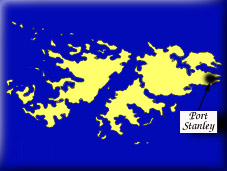
A civil British colony didn't really get started until 1841 when the Colonial Land and Emigration Commissioners recommended the formation of a colony. Lt. Richard Moody became the first British Governor in 1843, establishing Stanley as the Islands' new capital. One of the most difficult problems of the new administration was attracting migrants. It's remoteness, weather and lack of building materials did not make it the first choice of many Britons in the 19th Century. It did receive a boost in the late 1840s due to the discovery of Gold in California. At the time, the fastest way to travel from Europe to California by ship was to go around Cape Horn or through the Magellan Straits. The 1840s was a period before steam had taken hold in the powering of ships. Sailing ships docked at the Falklands before attempting the hazardous journey around the bottom tip of South America in order to make sure they were in tip-top condition for the harsh journey. Returning ships would often dock at Stanley in order to complete essential repairs before continuing the 8,000 mile journey back to Europe or North America. This boom in traffic saw a rise in economic activity and a number of travellers stopped off in the islands thanks to the growing opportunities there. In 1849, the government encouraged 30 military pensioners and their family to embark for the islands. The intention was for these to replace the existing garrison and take on a paramilitary and civil policing role. This system of transplanting veterans was thought to be a cost effective way of embedding a loyal population on the islands who would have the skills and experience to organise a defence if the need should ever arise.
With a small but growing population, the colony needed to pay for its administration and infrastructural development. Natural resources were what had long attracted fishing, sealing and whaling ships to the area. Other ships docked to try and get meat from the wild cattle roaming the islands since the French had abandoned them all those years earlier. Alexander and Samuel Lafone helped set up the Royal Falkland Land, Cattle, Seal and Whale Fishery Company in 1851 and received a Royal Charter the following year. It was renamed as the Falkland Islands Company and it tried to make the islands economically viable and create products that would be of use to passing ships and for export back to Europe. It is ironic that the company would go on to become famous for an animal not listed it its original charter; sheep. In the 1850s, it was realised that the lands might be more suited to hardy brands of sheep that could survive the conditions on the islands. This proved to be the case and the Company became an exporter of wool on a large scale. The Falkland Islands Company had managed to realise what Luis Vernet had hoped that he could achieve with his company all those years earlier. It is no coincidence that in the same year of the Royal Charter being awarded, Luis Vernet at long last received compensation from the British government for his outstanding claims resulting from the British arrival in 1833. Both parties wished to tidy up their affairs and remove any source of controversy or dispute. The Falkland Islands Company was the new commercial entity in the islands with extensive land holdings and rights to use the resources of the island, both on land and water. However, this move to commercial viability meant that the Americans once again felt that their interests in the economic use of the islands were being undermined. They had provided the instrument to undermine Luis Vernet's monopoly back in 1831 and were now concerned that the Falkland Islands Company would take over that role now and exclude them once more.
The Americans had never been completely reconciled to the islands being administered as a British colony rather than as an open island chain that could be used by anyone. Tensions between the US and Britain were already strained over disputes about the land border between Canada and the USA at the time. It would not have taken much to trigger off a war between the two nations, and the Falklands very nearly provided a casus belli, just as it had nearly done between Britain and Spain back in 1770. In 1854 two American whalers were catching whales around the islands and were going ashore to take wild cattle to feed their crews. The Falkland Islands Company complained to the governor who sent for a British ship from the Brazil station. The captain of the British ship, Henry Boys, apprehended the whalers and their crews and brought them to Port Stanley to stand trial for poaching illegally. The American government ordered a much larger American warship, Germantoun, to intimidate the British into surrendering the American citizens and handing them back. They were insisting that they had every right to use the resources on and around the islands. The Germantoun went so far as to train some of its guns on the courthouse being used for the trial and other guns were trained onto the much smaller British ship, HMS Express. The British captain, Boys, stood his ground and trained his own, smaller guns, back onto the American ship. He dared the Americans to start an international incident and perhaps ignite a war. The American captain stood down. The trial of the captains of the whalers continued and the danger of a clash subsided. By this action, the Americans had been forced to recognise British rights to economic exploitation of the islands. They never again tested the right of Britain's ownership of the islands.
The arrival of a stable civil administration and the ideal location of the islands off the coast of South America made the Falkland Islands an ideal base for Christian missionary activity. In 1855, the South American Missionary Society identified the Falklands as being the perfect base for their prosyletizing mission. They would have the blessing of the local administrators and would have a safe haven from which to coordinate and launch missionary activity in Patagonia and Tierra del Fuego. They set up a mission on Keppel Island and despatched their mission ship Allen Gardiner hither and thither in the search for souls. There was a serious setback to the mission in 1859 when all but one of the crew of the mission ship was murdered at Wulaia in Tierra del Fuego. There was a great clamour on the islands to punish the barbarous acts of the heathens but cooler heads prevailed and missionary activity resumed. In 1869, the Falkland Islands were elevated to being a full Bishopric within the Anglican Church with W. H. Stirling being ordained as the first Bishop of the Falkland Islands. His See actually ran to the majority of the South American continent. A cathedral was built in Stanley by Arthur Blomfield to recognise the new diocese.
Port Stanley thrived for much of the Nineteenth Century but gradually it began to lose some of its strategic value. With the advent of steam power, ships could travel further and faster without the need for stopping so frequently. Iron hulled ships meant that they did not need to stop for repairs before or after rounding Cape Horn. Ships could also travel longer without having to get fresh victuals with the increasing availability of tin cans and refrigeration. To cap it all off, the Panama Canal was opened in 1914 providing a much faster, safer and more efficient route between the Pacific and the Atlantic. There were still whaling and sealing ships operating in the South Atlantic, but even these were diminishing with more efficient forms of oil being discovered and less demand for their meat products. It was clear that the island's strategic position was not going to be quite as important as some naval strategists had predicted. And yet, the First World War would Illustrate that they still could play a valuable military role after all.
|
|
The Twentieth Century
|
|
1908 saw the administrative region governed from the islands expand enormously as the South Sandwich Islands, South Georgia, the South Shetlands, the South Orkney Islands and a region of Antarctica known as Graham's Land became a part of what was known as the Falkland Islands Dependencies (FIDs). The governor of the Falkland Islands also took control and the day to day running of these dependencies. Only South Georgia had a population of any kind, although a largely transitory one based on the whaling industry. This was the period of intense Antarctic exploration as the continent became one of the final frontiers for mankind to get to grips with and begin to understand. It was only natural that many of these explorers, Scott, Shackleton, William Speirs Bruce used the ports and facilities at Stanley and South Georgia before, during and after their expeditions. Britain's Antarctic claims were formally increased in 1917 on the 'sector principle' as was used in the Arctic claims of the time. For a while, the British considered annexing the entire Antarctic continent, but it was clear that other nations were equally interested in claiming the lands.
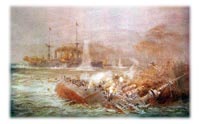
The new century had brought the benefits of improved communications to the isolated islands with wireless telegraphy. in 1911, a telegraph station was constructed two miles outside of Port Stanley which communicated to Buenos Aires and Monte Video and then connected onwards to Europe and Britain. This development came just in time for the First World War and allowed the Falkland Islands to play a major role in allowing the Royal Navy to intercept the German Pacific Fleet as it tried to return to Europe via Cape Horn. The Islands were proving that they still could act as a valuable choke point between the Pacific and the Atlantic - much as Anson had foreseen all those years before. For the rest of the war, the islands served as a Naval base to allow RN ships to patrol the seas off South America and board neutral shipping to ensure that no supplies were going to the Central Powers. The islands also acted as a vital refuelling point for the Royal Navy and allowed ships to move from the Atlantic to the Pacific without being spotted as would have happened if they had used the Panama Canal.
After the war, the islands benefitted from yet further improvements in radio broadcasting technology. Under the auspices of Governor Arnold Hodson the BBC were encouraged to connect the islands to their broadcast system and to create a local radio capability too. This allowed the islands to receive communications from Britain almost instantaneously for the first time in history. It was all a part of using modern technology to connect the disparate empire together and the Falklands were felt to be more isolated than most. In 1933, King George V was able to broadcast directly to the islands on the occasion of the centenary of the arrival of Captain Onslow on HMS Clio. He emphasised the manner in which the Falkland Islanders were tied to the mother country 'by the closest ties of kinship and loyalty.' Royal Naval ships called into port and there were great celebrations on this centenary occasion. However, these celebrations awakened Argentinian sensibilities and began a period of sustained diplomatic tension between the two countries.
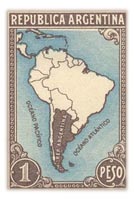
Britain and Argentina were important trading partners especially with agricultural products. However, the 1930s had seen a downturn in world trade after the Wall Street Crash and the Great Depression. Countries were closing their markets to one another in an attempt to support their own farmers and products. Argentina suffered more than most due to the size of its agricultural sector in its economy. Populist solutions to these difficult economic times were seen as tempting alternatives to politicians struggling to come up with answers to the economic problems of the day. The Argentinian government responded by reminding its population of its own claims to the islands. It issued stamps and maps showing the islands as being an integral part of Argentina. They began to query passports with Falkland Island stamps within them and generally making it cumbersome for Falkland Islanders in particular to stop off in Buenos Aires whilst travelling to and from the islands. This started a long period of drawn out obstructionism from Argentine authorities.
The Second World War would once again show that the islands were strategically well placed to help the British war effort. This was evident with one of the first successful British operations of the Second World War, the Battle of the River Plate. Once again, the islands proved a perfect base for the Royal Navy to hunt down and destroy the powerful German battleship Graf Spee. The victorious British fleet then hobbled back into the Falkland Islands for vital repairs. Late 1941 and early 1942 saw a new threat to the Islands as planners feared that the Japanese might make a strike towards the islands in order to ensure a severance of the communications lines between the Atlantic and Pacific and establish their own bridgehead into the West. There were no such plans by the Japanese, but the fear of a possible strike on the islands in the aftermath of the surprise attacks on Pearl Harbor, Hong Kong and Malaya certainly added to heightened tensions. The Royal Navy and FIDF were placed on high alert and ordered to remain vigilant for the duration of the war.
The role of Argentina in World War Two was an additional concern. It seemed clear that elements of the Argentine military were openly sympathetic with Nazi Germany. Having said that, many in Argentina were still wedded to the Allied cause and Argentina had historically strong trade links with Britain. Elements of the Buenos Aires Anglo-Argentine community volunteered to travel to the Falkland Islands at the outbreak of the war to defend them in case of a German attack on the islands. This force came to be known as the Tabaris Highlanders, rather insalubriously named after a Buenos Aires nightclub with 'something of a reputation.' The force was later absorbed into the Falkland Islands Defence Force or its members joined directly into the British armed forces but was welcomed as a show of support for the Allied cause. Argentina itself stayed neutral as it attempted to balance the competing calls for intervention on behalf of one side or the other. This neutrality suited Britain in the early stages of the war as it allowed the Argentinians to export much needed beef to Britain without falling foul of the American 'neutrality' acts that punished dealings with belligerent nations. However, when America joined the war, they were not so forgiving of continued Argentinian neutrality and lobbied hard for a declaration of war. The already weakened democratic government of Argentina was overthrown and a set of military coups started which dogged the country for the next half century. The dangers of declaring support for one side or the other was manifested in 1944 when the military ruler General Ramirez suspended relations with the axis powers and was then promptly deposed by other military rivals. Argentina eventually declared war on the Axis in 1945 when it was obvious to all that Germany was heading for a catastrophic defeat. The Falkland Islands were fortunate that the chronic political disagreements within Argentina paralysed the country at a time that it may have been possible to take advantage of British precariousness in the European war. The Argentine government did make some moves to expand their claims to land in Antarctica, the South Shetlands and the South Orkney Islands. The Royal Navy did have to divert ships in order to remove markers of ownership placed by Argentine ships on these uninhabited islands. The British then despatched a small force to Deception Island and Graham's Land for the purpose of 'effective operation' and to forestall Argentinian designs on British claimed lands in what came to be known as Operation Tabarin. Despite the Argentinian push for claims in the unoccupied lands to the south they never considered invading or taking control of the Falkland Islands directly. However, despite surviving this period of threat a new and more powerful political force was rising in Argentina under the leadership of General Peron. His new populist line would indeed imperil the Falkland Islands in the post-war period.
The more the military took control of Argentinian political discourse, the more nationalistic and populist became their calls and the more aggressive their stance towards the sovereignty of the Falkland Islands. And yet at the same time, the less democratic and more politically chaotic Argentina became, the less interested the Falkland Islanders were in considering Argentinian sovereignty. Meanwhile, the succession of generals in post-war Argentine politics thought that mobilising Argentine opinion in recovering the Malvinas was a quick way of gaining popularity and in justifying the considerable military budgets they were allocating for themselves. Provocative action from Argentina was often used during periods of Economic distress and to distract popular opinion from the day to day realities of a country that was losing its relative wealth and standard of living at an alarming rate.
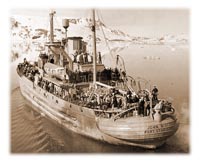
One such clash was at Hope Bay in the FIDs territory on the Antarctic Continent in 1952. A British ship, the John Biscoe, was bringing a crew of scientists and engineers to rebuild a British base that had been destroyed by fire. They were surprised to come across an Argentine hut built only a few hundred yards from the abandoned British station. When the British team came ashore they were warned that they were entering Argentine territory. The Argentine Base Leader said: "I am instructed by my Commander to prevent you building a base here using force, if necessary." The British scientists ignored the warning but soon afterwards were fired upon by an Argentinian machine gun. The bullets passed over their heads but it was clear that the unarmed scientists had no means of resisting this aggressive act and so retired back to their ship. Rather than recall the ship, as the Argentinians hoped, the British despatched HMS Burghead Bay which was on station in the Falklands at the time. A force of Royal Marines landed at Hope Bay and chased off the Argentinians into the interior. The base was then built with Royal Marine protection. The swift response of the local commanders on the ground ensured that the issue was resolved to the satisfaction of the British position. But it hinted at darker times ahead for British-Argentine relations.
The post-war period saw a fundamental shift in the trading relationship between Britain and Argentina. In the Nineteenth Century, Britain had been a leading investor in the Argentine economy and had been its most important customer for agricultural products, especially its beef. Britain had come out of the Second World War in a much more precarious economic state. It was no longer a major economic big hitter and its importance to the Argentine economy declined. Political instability in Argentina eroded its own economic potential and curtailed investment into the country. Ties were weakening between the two nations as both economies declined in their relative importance to the world economy.
The post-war period was also a period of decolonisation as successive British governments embarked and then speeded up its divestment of territories and colonies all over the world. This period of decolonisation encouraged the Argentinian government to think that the British might be willing to give up control over the Falkland Islands. This seemed to be confirmed by Britain's eventual accession into the European Union. It seemed to confirm that Britain had definitively left its empire behind and had now emphatically entered a new post-colonial period. It also meant that Britain was expected to purchase agricultural goods from its European neighbours rather than from its traditional suppliers like Argentina - and so further weaken trade ties between the two nations.
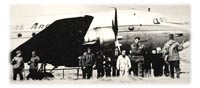
Impatient for change and encouraged by nationalist propaganda at home, some Argentinian activists took matters into their own hands. In 1964 an Argentine pilot flew a plane to Stanley, planted a flag on the ground and claimed the islands on behalf of Argentina. Two years later an Argentinian Airlines DC-4 was hijacked by 20 young Argentinians and forced it to land at the racetrack in Stanley in what was known as 'Operation Condor'. These publicity stunts backfired with regards to the Falkland Islands' population who were not impressed by the actions of these hotheads and what it might mean for their culture if they were absorbed into Argentina itself. It also had the effect of helping the British government decide to station a permanent, if small, Royal Marine garrison on the islands in order to deal with any future disturbances from Argentine nationalists.
Argentina turned to the United Nations and the Organisation of American States for diplomatic support in making its own claims. It was fully aware that the United Nations was filling up with ex-colonies and a growing non-aligned group of nations who were happy to hold the old colonial masters to account. It was therefore not surprising that they were able to pass a resolution through the General Assembly in 1965 encouraging both parties to proceed with negotiations for a peaceful solution to the problem of sovereignty. Neither Britain nor the Islands had thought that there had been a problem of sovereignty but this resolution thought otherwise.
It has to be said that British commitment to the islands was not always clear-cut. As Britain's defence capabilities declined and her budget and economy weakened, it was becoming increasingly difficult to justify a blank cheque approach to defending the islands. Their distance from Britain compared to their proximity to Argentina would mean that Britain would have a much more difficult time moving forces to the islands quickly enough to forestall or prevent any invasion. Some diplomats in the Foreign Office were also concerned that the rights of 2,000 islanders were becoming obstructive to good relations with a major South American economy and having negative knock on effects with other South American countries. The idea of transferring sovereignty to the Argentinians in a gradual form through leaseback or condominium was openly considered. The UN mandated negotiations opened in 1967 but it kept stumbling over the rights of the Falkland Islanders themselves to have a say in the ownership of their islands. The Argentinians felt that the islanders would never agree to a change in sovereignty and so the islanders should not be given a veto that they would inevitably use. In 1968, the British government of the day came close to acceding to these demands when it agreed to remove its own demands that any agreement should be acceptable to the inhabitants of the Falkland Islands to give satisfactory assurance of respect for the interests of the Islanders. This would have effectively removed the right of Falkland Islanders to have a right in the say of their sovereignty. Various actors in the negotiations were disturbed at the secret changes being planned to undermine Falkland Islander say in their future and leaked the proposals to MPs and the Press. There was a public outcry in Britain at the seemingly duplicitous nature of the negotiations and the government was forced to back-track and restate the official government line of giving the islanders a full say in the sovereignty of their islands. The talks later collapsed as the Argentinians were disappointed to sign any document other than the one that removed the rights of the Falkland Islanders to agree to any transference of sovereignty.
Elements in the British government were still concerned at the long term viability of the colony and worried that her isolation from the mainland of Argentina would make it even harder for her economy to develop. Britain in the late 60s and early 1970s was undergoing dire economic hardship and there were increased calls to retrench defence cuts. Attempts were once again made to improve relations between Argentina and the Islands. The Foreign Office case was that increased contact and trade between the mainland and the islanders would pave the way for improved relations. With this in mind, the government once again initiated a secretive deal with the Argentinians to initiate a Communications Treaty between the two nations. The idea was that Islanders would be free to travel to Argentina, direct air and sea links would be set up between the Islands and Argentina, and post and telephone rates would be harmonised. It would also allow Britain to cut back on its own subsidised shipping link with the islands. The Argentines even agreed to build a temporary airstrip and run a weekly service to and from the mainland. However, 1973 saw the return of Peron and his Peronistas to power and these were more inclined to take a hardline nationalist approach to relations with the island. This had the effect of alienating Falkland Island sensibilities yet further. The return of full blown military dictatorships in 1976 concerned them even more and this was even before public knowledge of the 'Dirty War' conducted by the generals became known to the world.
Almost straight away the military leadership returned to its antagonistic and provocative measures in pursuing its claims. A British Antarctic Survey research ship, RSS Ernest Shackleton, was fired upon by an Argentine gunboat and pursued back to Stanley. Another British Antarctic Survey research ship RSS Bransfield discovered a secret Argentine base on South Thule, an uninhabited island in the South Sandwich Islands. Britain was so concerned at the rising tensions of this period that they sent a small task force to the Atlantic to support a submarine to patrol the waters around the islands. The government was certainly anticipating the possibility of an invasion.
During this period of heightened tensions, the British government commissioned Edward Shackleton to write a report on the economic viability of the islands. It was assumed by those who commissioned him that he would find that the islands' long term future was economically unviable and that an accommodation with Argentina would have to be made in order to secure its continued existence as a going concern. To the surprise of the officials, his report was surprisingly upbeat about the potential future of the islands. He found a hardy and resourceful people who consistently exported more than they imported and were keen to retain British sovereignty and way of life. He recommended that infrastructural improvements be made but essentially thought that the islands were viable although recognised that the defence costs would remain considerable.
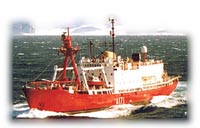
The election of the Conservatives in 1979 seemed at first hand to give hope of improved support from Britain. And yet, Britain fell into an even deeper recession that required even further cuts in defence. The Royal Navy was singled out for particularly severe cuts to its surface fleet and this included the Antarctic supply vessel HMS Endurance and its remaining aircraft carriers. The message to the military dictatorship in Argentina was that it was losing its capability to defend the islands as well as diminishing its commitment to the islands. Argentina was undergoing its own economic meltdown and the generals could not avoid the blame as they had been in control of the country for so long. There was also considerable internal unrest as details of the 'dirty war' and the harsh methods of control were becoming known to a larger audience. General Galtieri and his ruling Junta assumed that an invasion of the islands would unite the faltering country behind its leadership and divert attention from its failings. They also assumed that the British lacked the will and were losing the ability to defend the islands. Further details of the events of the war can be read on these pages: The Falklands War.
Paradoxically, the invasion galvanised the country of Argentina's rival; Britain. Margaret Thatcher was the one to benefit from uniting her country with her determined response to restore British sovereignty at considerable military and financial cost. The aircraft carriers that had already been sold were still in British dockyards and were yanked back into British service. A large naval exercise happened to be taking place in the Atlantic at the time and diverted itself to the South Atlantic. The invasion invalidated Argentine claims to be negotiating peacefully and gave the diplomatic high-ground to the British who used it to have the United Nations condemn the invasion. Argentina also found out that her ally America was closer politically and culturally to Britain and so found herself isolated. Even neighbouring countries like Chile sided with Britain and offered support and help to the British campaign. The lamentable effort of the Argentine army and navy (but not air force) in defending the islands undermined the credibility of the military junta. If the military couldn't even get their armed forces operating efficiently, how could they be trusted with civil society and the Argentine economy. The whole affair was a disaster for Galtieri and the Junta and they were swept aside in a backlash of anger by the Argentine public.
Since 1982, Britain has invested a considerable amount in the defence of the islands with improved runways, port facilities and the construction of a large new military base at Mount Pleasant. This investment confirms Britain's commitment to defending the islands and preserving the right of self-determination for the islanders. The economic potential for the islands has also improved in the post-Falklands War period. Firstly, victory meant that the British were no longer hesitant in proclaiming the maximum economic rights to the seas around the islands. Licenses to fish the rich stocks in the South Atlantic have been issued from the governor of the Falkland Islands, bringing in a steady and considerable income for the islands. Furthermore, oil and gas reservers have been discovered within their territorial waters and attempts are being made to extract these reserves. If defence is taken out of the equation, the islands are more than self-financing. The population of the islands also saw a mini-boom in the post war period and it now stands at over 3,000. The current figure surpassed the previous high which was at the outbreak of the Great Depression in 1931. Lured by economic potential, or from an increased awareness of the islands thanks to the publicity generated by the war, or from ex-servicemen who served during the war and wished to return to the islands to make a livelihood, the future of the Falkland Islands seems healthier than it has for a long time. It is perhaps ironic that a war that nearly destroyed the community of the islands has ended up uniting official and public opinion into fully supporting and aiding the islands' development and future.
|
|
|
|