

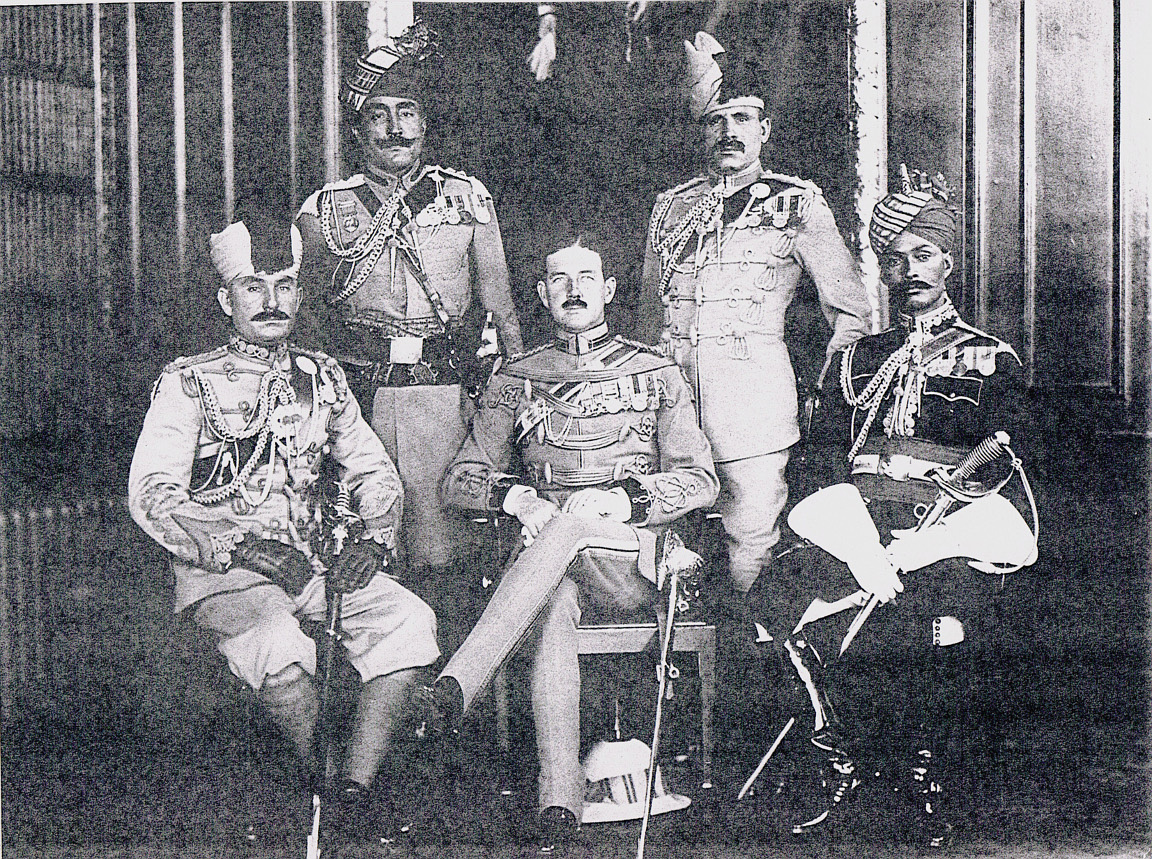
Seated left: Subadar-Major Amin Gul, 2nd Battalion 14th Punjab Regiment. This was the 20th (Duke of Cambridge’s Own) Brownlow’s Punjabis. The officer wears the dress uniform of the former 20th Brownlow’s Punjabis; drab with emerald green facings and drab lace, braid and cords. The elaborate lace and braid on his cuffs and collar denote his senior rank. Up until the date of this photo, Indian infantry officers had worn much simpler uniforms. This uniform appears to be worn in defiance of orders because the six regiments that comprised the newly organised 14th Punjab Regiment were required to wear a scarlet tunic with green facings. His khaki turban has a green pointed kullah and a green fringe hanging on the front. This officer was a Pashtun. The 20th, in 1914, comprised four companies of Pashtuns, two of Sikhs and two of Dogras.
Seated centre: Major Norman Henry Prendergast DSO MVO, 5/12 Frontier Force (Queen Victoria’s Own Corps of Guides). Major Prendergast served in the Guides Infantry while Risaldar Zardad Khan, standing behind his right shoulder, was an officer in the Guides Cavalry. This Corps had been a combination of the two fighting arms since 1846 but were split in 1911 and remained split after the First World War. The infantry remained on the North-West Frontier and in the Middle East during the war although one company went to France in 1914, attached to 57th Wilde’s Rifles.
Norman Henry Prendergast was born in Clawton, Devon, the son of Colonel J. H. Prendergast. He reached the rank of lieutenant on 14 April 1908 having recently transferred into the Guides. He fought on the North-West Frontier in 1908, in the Mohmand country, and earned a medal and clasp. Prendergast distinguished himself once more on the Frontier in 1915. The London Gazette of 20 March 1916 said, ‘…after escaping in most marvellous manner from a hopeless situation, was given command of the flank attack and carried out his independent command with conspicuous coolness and energy. A fine young officer.’
But it seems that his award of the Distinguished Service Order (DSO) was not to come until 1919. The Gazette of 25 November 1919: ‘Capt. Norman Henry Prendergast, Queen Victoria’s Own Corps of Guides, attd. North Waziristan Militia I.A. (INDIA). He has led detachments of his corps gallantly on all operations, especially on 27th May 1919, at Miranshah, and has always shown high, soldierly qualities. The fact that practically the whole of his corps has remained loyal is chiefly due to his personal influence and power of command.’
From January to June 1941 he was appointed Assistant Adjutant-General in India. The appointment refers to him: ‘Colonel (acting) N. H. Prendergast DSO MVO., Ret Indian Army.’
Seated right: Risaldar-Major Amir Muhammad Khan, Bahadur IDSM OBI, 3rd Cavalry. The 3rd was formed in 1922 by the amalgamation of the 5th and 8th Cavalry. Amir Muhammad Khan was an officer of the former 5th Cavalry. He wears a scarlet kurta, including the collar, with gold lace and braid, the dress uniform of the 5th Cavalry. After 1922 the regiment was required to wear a blue kurta with primrose yellow facings. The 5th Cavalry was kept in India for most of the First World War but went to Mesopotamia in 1918. As a Ressaidar he had been awarded the Indian Distinguished Service Medal for his service in Mesopotamia. He had already been honoured with the title Bahadur, and he was appointed to the Order of British India 2nd Class. He was a Hindustani Muslim, the only officer in the group not a Pashtun. The 5th Cavalry, in 1914, was stationed at Rawalpindi, comprising two squadrons of Hindustani Muslims, one of Rajputs and one squadron of Jats.
Standing left: Risaldar Zardad Khan IDSM, 10th Queen Victoria’s Own Corps of Guides Cavalry (Frontier Force). From 1911 the Guides Cavalry had operated separately from the Corps infantry, and had been given the 10th rank in the Indian Cavalry line. In the First World War they served on the North-West Frontier until November 1917 when they joined 11 Indian Cavalry Brigade in Mesopotamia, taking part in actions at Sharqat and Khan Baghdadi. After the Armistice they remained in Persia to counter a Bolshevik threat, returning to India, to their base at Mardan, in 1921.
The Risaldar was a Pashtun, serving in the Pashtun Squadron. The Guides also had a squadron of Sikhs and a half-squadron of Dogras and Punjabi Hindus, and another half-squadron of Punjabi Muslims. His uniform is very different from that worn by British officers, as demonstrated by Major Prendergast who was in the Guides Infantry. The Risaldar wears a khaki or drab kurta with scarlet facings and drab lace and braid. He has silver shoulder chains and a pouch-belt on his left shoulder worn with a Sam Browne belt which supports his sword. He has an extensive row of medals which includes the Indian Distinguished Service Medal which he earned in Mesopotamia.
Standing right: Subadar Yar Ghulam, 4th Battalion 13th Frontier Force Rifles, formerly 57th Wilde’s Rifles. Wilde’s Rifles served in many places in the First World War: India, France, Egypt, German East Africa, and raised a second battalion that remained in India. The 1st Battalion comprised two companies of Sikhs, two of Dogras, two of Punjabi Muslims and two of Afridi Pashtuns, to which Subadar Yar Ghulam belonged. The uniform of the 57th Wilde’s Rifles was khaki with Prussian blue facings, including the fringe on his khaki turban. However, the uniform he wears in this photo is khaki, but has pale facings. After 1922 the newly formed 13th Frontier Force Rifles were obliged to adopt a rifle green uniform with scarlet facings for all six battalions.
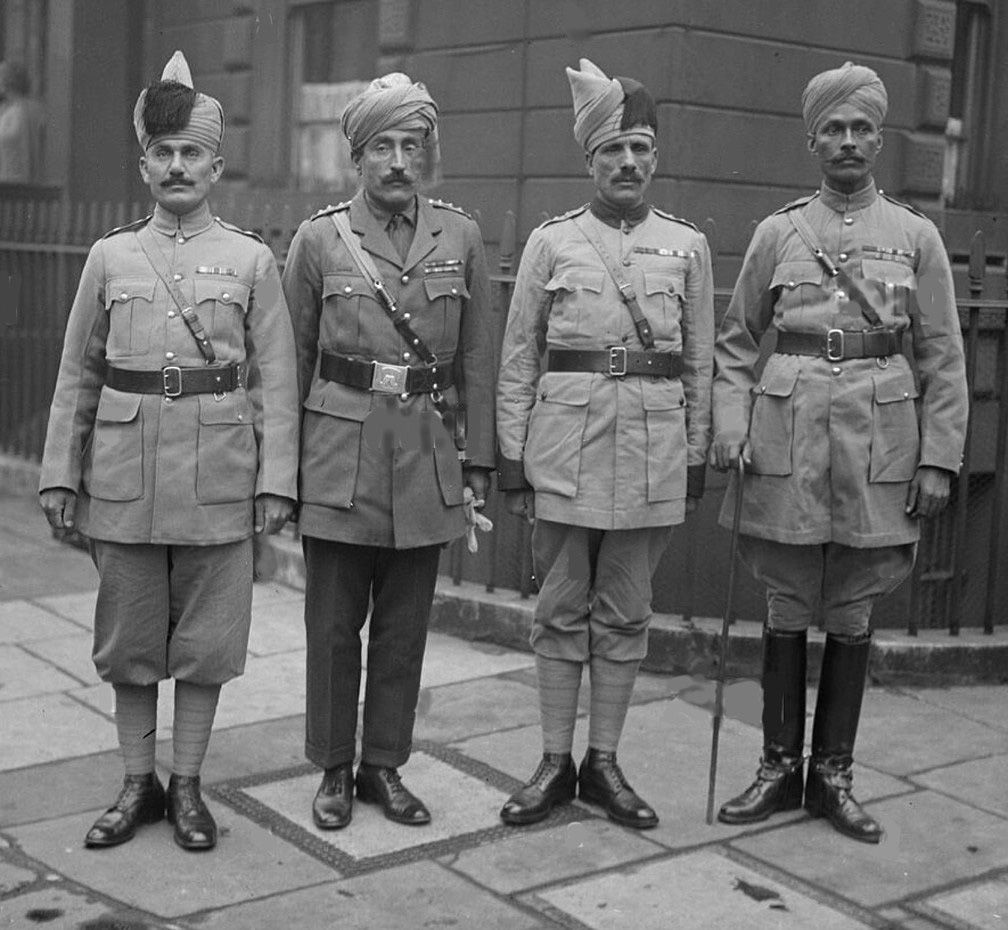
The Indian officers selected for the duty of attending the King for the court season of 1924 are, in this photo, wearing different shades of khaki service dress. From the left:
Subadar-Major Amin Gul, 2/14th Punjab Regiment (Brownlow’s)
Risaldar Zaidad Khan IDSM, Guides Cavalry
Subadar Yar Ghulam, 4/13th Frontier Force (Wilde’s Rifles)
Risaldar-Major Amir Muhammad Khan, Bahadur IDSM OBI, 3rd Cavalry.
The tunics are all long-skirted and fastened at the neck, except for Risaldar Zaidad Khan who has lapels with shirt and tie. The two cavalry officers have whistles attached to their Sam Browne shoulder belts. Subadar-Major Amin Gul has a green fringe on the front of his khaki turban, and Subadar Yar Ghulam has a blue fringe. He also has Prussian blue cuffs and collar, a distinction of the 4th Battalion 13th Frontier Force (Wilde’s Rifles). He also has the special small black buttons to signify that he is a rifles officer. Also of note is the rectangular belt plate of Risaldar Zaidad Khan of the 10th QVO Corps of Guides Cavalry.
The photo was taken outside 49 St George’s Road, Pimlico, where the King’s Indian Orderly officers were quartered for their stay in London from April to August 1924. A photo was taken previously in 1922 of the KIOs outside no.49.
