Letters Home
Keith Arrowsmith has kindly made available the letters that he sent to his parents after he arrived to work with the Colonial Service in Nigeria in 1949 and 1950.
Odd Jobs and Diplomatic Interludes
Dogon Yaro gives some examples of the sheer variety of work for a Provincial Officer in Northern Nigeria from the immediate Post-War period and on into post-independence Nigeria.
An African Experience in Retrospect
Malcolm F Anderson spent two decades living and working in Nigeria as a surveyor. The fact that his career straddled the colonial and independence periods has allowed him to evaluate the relative merits of the two systems. He had stayed on in Nigeria with the best of intentions but explains how his professional frustrations slowly increased and undermined the important work he was doing in helping Nigeria to develop and transition to a more modern economy.
Gordon Aitken Citation
An example of the difficulties faced by the Colonial Police Force in Nigeria in the 1950s and how its officers responded.
Bush Paths: Nigeria 1949 - 1957
Keith Arrowsmith gives an insight into the roles and responsibilities of an Assitant District Officer and District Officer in Eastern Nigeria in the 1950s.
Notes on My Time in Northern Nigeria: January 1948 - August 1960
Robert Longmore has written a full account of his time working as a Colonial Officer in Northern Nigeria in the Post-War period right up to Nigerian Independence.
In Our Defence
John Smith considers just how fairly the history of the British Empire will be considered and relates how even Chinua Achebe credited British Imperial rule with giving some very real benefits to Nigeria.
On Tour - but in London!
John Smith gives an account of one of his more unusual tours as a Colonial Civil Servant when he was required to travel to London no less. He was to accompany the Governor of Northern Nigeria to the important 1957 Nigerian Constitutional Conference. This was part of a series of meetings to discuss the constitutional arrangements for Nigeria's forthcoming independence.
The Bijou Rest Houses of the North
Malcolm F Anderson explains the realities for a surveyor in finding suitable accommodation in the more remote parts of Northern Nigeria. The humble and often very basic 'Rest House' was the Colonial Government's solution, but the facilities found within these constructs could range from the primitive rustic to the almost non-existent.
The Baro Line
Former Colonial Service Medical Officer T.P. Eddy explains how he had to use an old fashioned and rickety 2 stroke rail waggon to travel through tropical Nigeria to visit a sick patient. The journey and his welcome made quite an impression.
The Nigerian Marine's War Effort
Captain Aubrey Dennis explains the important role played by the Nigerian Marine Department during the Second World War. He highlights the setbacks they suffered and the successes scored. He also recounts the role his own wife played in potentially saving his life after she decoded a message detailing the danger to a ship the author was due to pilot.
Trekking in Northern Nigeria, 1959
R G Lowe explains what it was like to undertake an expedition into the forests of central Nigeria in 1959. He goes into detail about the role of carriers and the kind of equipment they took and how they lived off the land whenever possible. The logistics of a government foot expedition were considerable to say the least.
Making Forest Reserves in Bornu - Northern Nigeria - 1956
R G Lowe recounts the practicalities of creating Forest Reserves. Using excerpts from his diaries he recounts the physical difficulties of marking out the boundaries and the lengths that they went to in order to explain the advantages to the local population.
Letter From West Africa
Greta Lowe volunteered to work in the Methodist Mission Society Hospital in Ilesha, Nigeria in the 1920s. This fascinating letter gives an account of her journey to this remote imperial spot, a meeting with the king of the region and life in and around a mission hospital.
The Day's Work and Odd Jobs: The Rogue Elephant
Ronald Bird gives an example of some of the dangerous jobs that a colonial administrator in Nigeria could be called upon to undertake on any given day.
Pioneer Nigeria
A former Colonial Agricultural Officer gives a brief overview of how an inspection regime was developed to help the farmers of Nigeria during the period of British control.
Who's Afraid?
Janet Wimbush recalls her time coming down from Plateau Province in Central Nigeria and coming across a real clash of cultures with tribesmen unused to European women.
The Bauchi Light
A. S. Webb gives an account of differences between local and western medical treatment along a Central Nigerian railway linking the plains to the plateau.
Our Side of the Tracks
Dr. T. P. Eddy explains the social divisions that were made apparent to all colonial servants in the inter-war years. He himself though explains how he was able to learn a little more about divisions in English society whilst talking to a locomotive superintendent in the middle of Nigeria.
The Fulani Boys at Jingari
A. S. Webb recalls the time he was on an inspection tour of the Bauchi Light Railway in Nigeria and was forced to have a layover in Jingari where he met missionaries with a remarkable tale of survival by two local boys attacked by a wild animal.
Journey to Yola, 1929
B.A. Babb takes us back to a time in Nigerian colonial history when just getting to a new posting could take weeks of arduous travelling.
He Needs a White Cloth
A. S. Webb explains some of the finer subtleties in negotiating local customs when it came to the death of a man in a railway workshop in Nigeria.
Iron Smelting in Northern Nigeria
H D L Corby describes a novel way of smelting iron that he saw developed in a small Northern Nigerian village.
A Nigerian Garden
Muriel Barnett recalls the perils, pitfalls but also the pleasures of doing battle with mother nature in the tropics.
In Bornu and Adamawa
Ronald Bird gives an overview of work as an Assistant District Officer in North-East Nigeria along the border with French concerns in the Cameroons and Chad.
Rescuing Miners on the Niger
Ronald Bird explains the time and effort required to respond to a message that miners were being held hostage on a small island in the middle of the mighty River Niger and how they got there just in time.
Niger Adventure - 1947
Joan Russell recalls an inspection tour of some of the schools in her district in Nigeria which required that she travel by canoe along the River Niger.
The Imoten Tree Story
R. F. Hooper explains the lengths that he had to go to when rioting broke out after locals in Nigeria blamed a French trader's wares for causing a hurricane.
An ADO in Zuru
N. C. McClintock goes into some detail in describing his life as an Assistant District Officer in a remote part of North Western Nigeria in the 1940s.
Historical Background to Boko Haram
John Hare explains how the North-East of Nigeria was no stranger to religious upheaval and radical Islamic influences. In fact, this instability was one of the reasons that the British were to create the colony of Northern Nigeria in the first place.
Nigeria: Life with Algar Robertson
Marjorie Lovatt Smith gives a candid account of her time in Nigeria in the dying days of Empire as she witnessed first hand as Britain prepared to hand over responsibility and authority to the Nigerians. She also recounts part of the role played by Algar Robertson in helping establish a central overseas civil service, with its own pension scheme, for officers serving in the colonies.
Bussa Rapids
Ronald Bird explains how he tried to revolutionise communications along the River Niger's most notorious stretch of rapids by attaching an outboard motor to the traditional boats that plied the waterways.
The Resident, Rivers Province
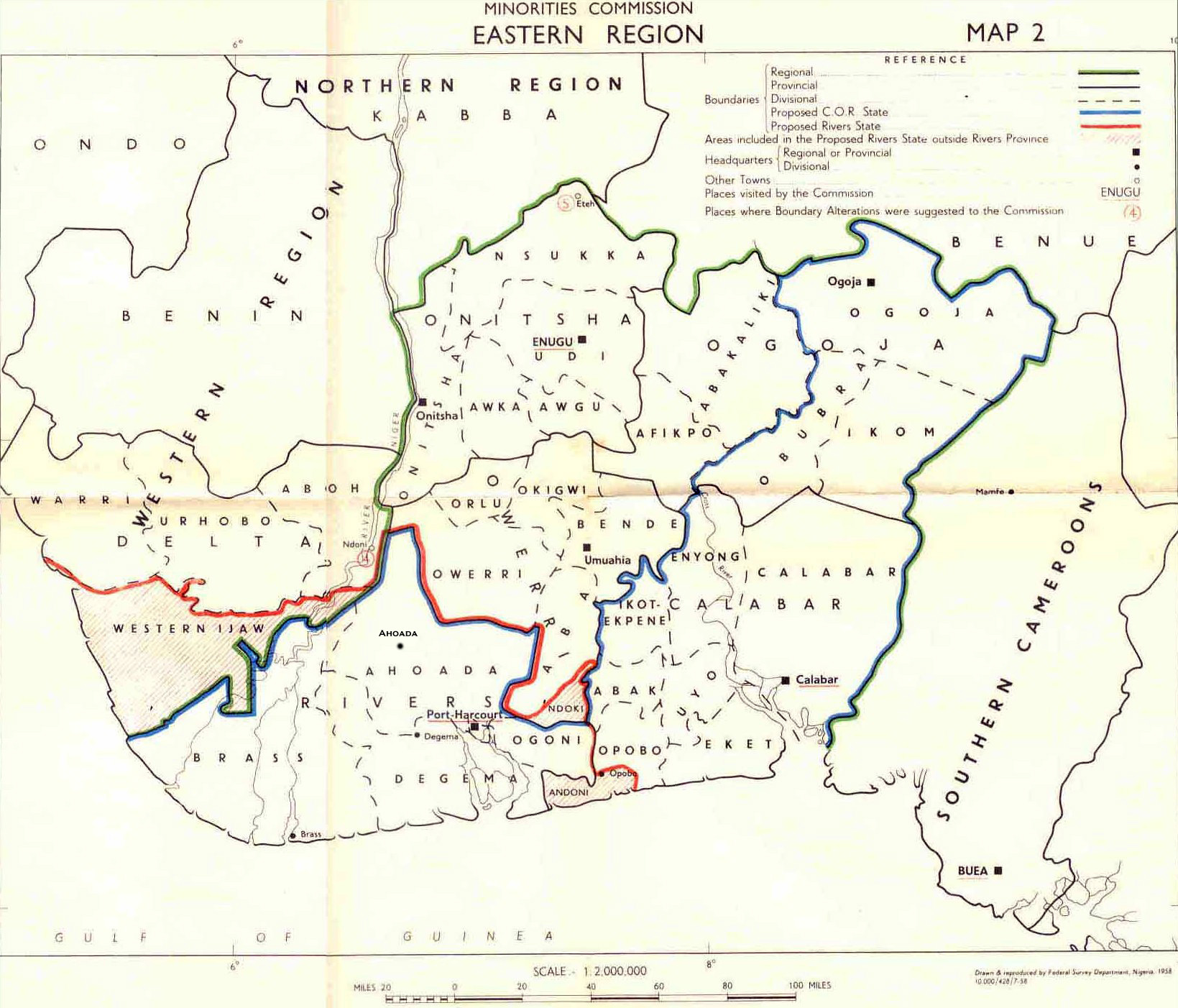
Manus Nunan explains how he helped set up the first Crown Counsel's Chambers in Port Harcourt in Eastern Nigeria and his dealings with an old-school British Resident.
Singing for my Supper
David Angus explains that when you are the ADC to a Governor-General and he asks you to sing unaccompanied to a party of over 100 dignataries in Northern Nigeria, you do exactly as requested.
Crichton Ian Gavin: A Man Vindicated
R G Anderson sees how this Nigerian colonial administrator was one of the early victims of the authorities pandering to local politicians who did not appreciate Gavin's efficiency and honesty.
The Day's Work and Odd Jobs:
Rough Games in Gwoza
Ronald Bird recounts how he had to administer justice between two warring and rambunctious villages in post-war North-Eastern Nigeria.
Le Ministre
Manus Nunan recalls the time that he went from British administered Nigeria to French administered Chad and considered the differences in approach to imperial rule in West Africa.
"Uh, uh! D.O. done come!"
John Adshead recounts how Hugh Sackville-West showed the soft power of British rule in Nigeria in quelling disturbances tactfully and with a minimum of fuss.
Major O'Driscoll
Manus Nunan explains the character of Major O'Driscoll who served in Kaduna in Northern Nigeria.
Curtains in Kaduna
Ruth Holmes recalls accompanying her husband to Kaduna in Nigeria in the 1950s and attempting to use local materials and fabrics to decorate her house only to discover that one pattern in particular had an alternative and already established association.
The Day's Work and Odd Jobs:
The Queen's visit to Jos
Ronald Bird remembers how he was expected to 'fit in' when the Queen came to the town where he was posted for a break from her hectic 1956 tour of Nigeria schedule.
Nigeria and the Colonial Experience
Reflections of a District Officer
Sir Francis Kennedy analyses the, at times, contradictory contribution made by colonialism in West Africa and its legacy in the post-colonial era.
Queen Elizabeth's Coronation Day
Keith Arrowsmith explains his attempts to celebrate the national holiday called in Nigeria to celebrate the crowning of Queen Elizabeth.
Legacies from the former Colonial Audit Service
Professor Jeffrey Ridley describes the establishment of the Colonial Audit Service and his own role in Nigeria before discussing the legacy to the wider Commonwealth of this organisation.